
Escalation Without an Off-Ramp
America's renewed war with Iran is accumulating casualties, costs, and escalation commitments faster than the administration can articulate a political end state.

The most important number in the Iran war this morning is not $37.5 billion.
It is nearly 100: the number of American service members injured since hostilities resumed two weeks ago. Four more service members have been killed in the days since the ceasefire collapsed.
Those figures do not capture the full human cost of the war’s first phase, from February through May, when the Pentagon recorded hundreds more injuries and 14 prior deaths. They do, however, describe the character of this renewed phase with uncomfortable clarity: this is not a brief aftershock to a war already won.
It is a live conflict in which American forces are again absorbing casualties, Iran is still able to strike regional bases and commercial shipping, and the United States has conducted more than a week of consecutive strikes. And there is little evidence that the trend is reversing.
Nevertheless, the administration continues to present Epic Fury as little more than a punitive operation: force applied to restore deterrence, impose costs, and compel Tehran to stop.
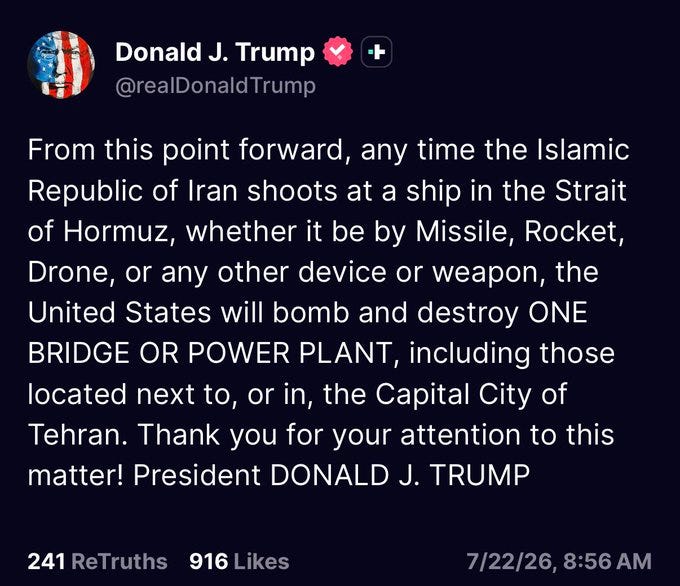
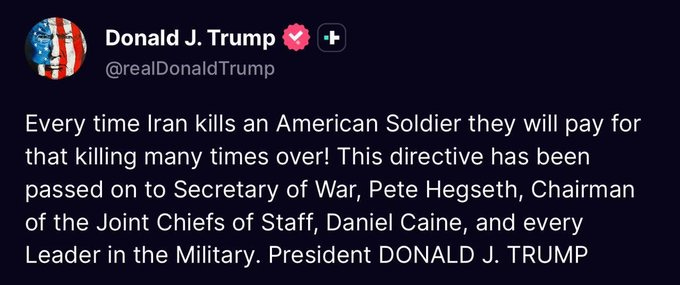
In principle, punishment can be part of a sound strategy, but in practice, the public theory now being articulated looks more like an escalatory algorithm. President Trump announced that any Iranian attack on a vessel in the Strait of Hormuz would bring the destruction of “one bridge or power plant,” including targets in or near Tehran. Two days earlier, he promised that every American death would be repaid “many times over.”
We’re not decrying the desire to punish aggression. Iran has been a central antagonist in the region for nearly five decades. But the President’s statements amount to a public commitment to persistent escalation—ceding control of the escalation ladder to the adversary.
That is not how limited war remains limited. Clausewitz understood that war, in its pure conceptual form, tends toward extremes. Each side tries to break the other’s will; each act of force creates pressure for a counteract; and violence can acquire its own internal momentum.
Real wars avoid becoming absolute because political purpose, friction, uncertainty, and restraint intervene. The political object should determine the scale of effort and, crucially, the point at which force has achieved enough. A policy that promises a larger American strike after every Iranian strike reverses that logic. It allows Iranian action, rather than American political purpose, to determine the tempo and scope of the campaign. It confuses retaliation with strategy.
There are operational and legal problems here as well. Bridges and power plants can have military significance, but they are also often dual-use infrastructure on which civilian life depends. Declaring them a pre-selected retaliatory category does not make the individual targeting judgments easier, nor does it explain how their destruction advances a defined political end state. It may satisfy the understandable desire to demonstrate resolve.
It also invites Iran to seek the asymmetric responses available to a weaker power: more attacks on exposed bases, commercial shipping, partners, infrastructure, and political confidence. Tehran does not need to win an exchange of strike packages. It needs only to make the United States choose between escalation, accommodation, and a protracted campaign it never intended to fight.
Tuesday’s congressional testimony exposed the underlying contradiction. SecDef Hegseth put the war’s cost at $37.5B and joined General Dan Caine in seeking roughly $67B in supplemental funds for operations, readiness, pay, replacement equipment, munitions, and production capacity. The request itself is evidence that the conflict cannot credibly be described as a completed punitive episode. The Pentagon says the supplemental is urgently needed to avoid shortfalls, with $46 billion tied to munitions and industrial capacity alone. This request doesn’t mean that the U.S. military has failed in fighting Iran. Wars cost money.
But this war remains without a clear political objective or a strategy for reaching one. It is a failure of civilian leadership in the White House and the Pentagon, not of the warfighter.
Washington may ultimately conclude that sustained military pressure is necessary. What it cannot do is sustain an expanding war while treating each Iranian response as proof that another round of punishment will finally close the account. The administration needs to say what political condition would end Epic Fury, what it is prepared to trade to reach that condition, and what escalation it will refuse even when Iran tries to provoke it. Until then, “punitive” is less a strategy than a reassuring label for a conflict whose costs, casualties, and momentum are already moving in the opposite direction.

Epic Fury - Part Deux!
Pentagon admits nearly 100 troops injured in last two weeks of Iran war (WP)
Pentagon identifies 4th service member killed in recent days as U.S. carries out more strikes (CBS)
War cost rises to $37.5B, Pentagon asks for $67.1B more in supplemental funding (MT)
Lebanese army enters southern town after Israeli withdrawal in first test of U.S.-brokered deal (RT)
Trump says U.S. will hit Iranian nuclear site at Pickaxe Mountain (ABC)
Shipowners are offering huge bonuses to get crews to sail the Strait of Hormuz (BBG)
News Headlines
After $400M of retrofits already, Qatari-gifted Air Force One now needs more upgrades to improve security (RT)
Coast Guard watches Chinese research vessel cutting through U.S. waters to the Arctic (MT)
New Executive Order tightens supply chain waiver rules, making it harder for defense contractors to get critical minerals and other materials (RT)
U.S. ratchets up tariffs with 50% on some Canadian goods (BBG)
China’s state-owned funds bought $9B of stocks to prop up their markets (WSJ)
Zelenskyy ousts Ukraine’s military commander as major shake-up continues (WP)
U.S. and Iraq signed $200B worth of energy deals (RT)
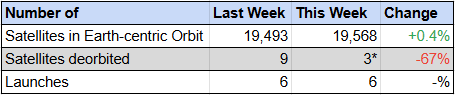
Satellites
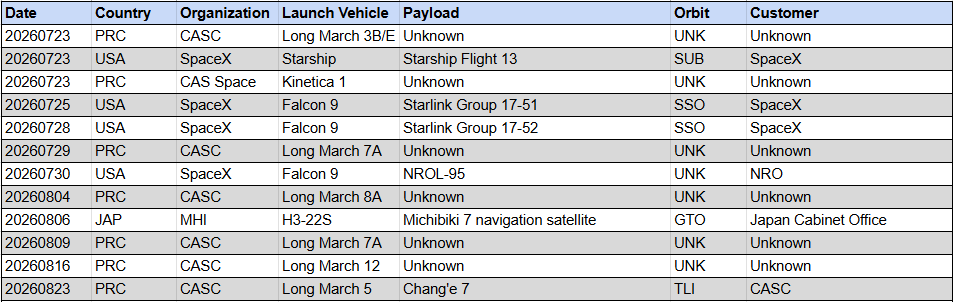
Launches
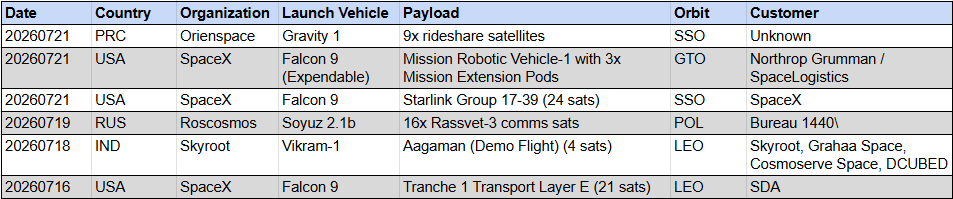
Upcoming Launches
Space News
Astronomers find the first atmosphere on a rocky world in a star’s habitable zone (SD)
A galactic collision may have made the Milky Way do a cartwheel, 10B years ago (PHYS)
U.S. Federal Space News
NASA’s nuclear Mars mission to cost $2.1B (GF)
Space Force faces budget uncertainty as chief plans exit next month (DO)
Chief of Space Operations nominee warns space increasingly becoming a warfighting domain (MT)
Nominee says that Space Force must continue to rebuild civilian staff after DOGE gutted service (MT)
Space Force swears in first batch of reservists (MT)
SDA orders 36 more Golden Dome missile-tracking satellites for $1.75B (SP)
The DoD increased the NSSL ceiling by $11.4B, tripling the pool of contracts (SATN)
Commercial Space News
Hawkeye 360 and Lockheed demonstrated downlink and processing of commercial space-based RF signals during DoD field training exercise Valiant Shield 2026 (ST)
Northrop adds to charges on Vulcan solid rocket motor program, suggests possible delay until end of year (SN)
SpaceX selloff is an ominous sign as lockup expiry looms (RT)
SpaceX launches Northrop MRV-MEP satellite repair drone with 10-foot robotic arm to service satellites in GEO (SP)
NASA warns SpaceX rocket debris could crash into the moon (SA)
Foreign Space News
China going ‘breathtakingly fast’ with space weapons: Space Force chief nominee (ASF)
China, Russia have secret plan to ‘defeat’ Starlink (AT)
U.K. commits additional $83M in new funds for SatCom and space tech (ST)
The U.K. is expanding its military space capabilities with new space squadrons (NI)
Electromagnetic Warfare
Space Force declares return to U.S. electromagnetic spectrum dominance following Iran ops (SATN)
Powerful electromagnetic battle management ecosystem completes first flight test (IE)
Russia turns to low-tech solutions like compasses in response to electromagnetic warfare (U24)
Russia, Ukraine intensify drone-centered EW as global military investment shifts toward drones, AI (TE)
British Army expands use of drones and EW to boost small unit lethality (ZM)
IAI unveils ELLYON AI-powered electromagnetic warfare aircraft (CT)
U.S. Army teams with Auriga Space to build and test electromagnetic weapon (IE)
Navy gives Boeing $25M for Super Hornet EW integration (MAE)
South Korea advances indigenous EW aircraft based on Bombardier Global 6500 (ZM)
Japan begins flight testing Kawasaki EC-2 EW aircraft (DF)
Deal Flow
Funds
Capitol Meridian Partners announced the final close of their $1.9B Fund II (WSJ)
VC
European space startup SWISSto12 raised a $70M Series C to scale its HummingSat offering (ST)
FLEXELL Space raised a $20M Series A to acquire critical manufacturing equipment and expand sample deliveries of its lightweight, flexible, tandem perovskite and CIGS solar cells (FSME)
Beyond Reach Labs, a space-focused startup addressing power bottlenecks, raised a $10M seed round from Interlagos, Y Combinator, and others
Chinese startup LegendSpace raised a $29.5M angel round to develop AI-driven rocket engine (VBN)
deltaVision raised an $11.64M seed round led by KT Ventures and Valemount Capital to build in-orbit refueling tech (PU)
PE / M&A / Other
Karman Space & Defense plans to acquire Glasgow-based Walker Precision Engineering for $94M to expand its presence into the United Kingdom (BW)
U.A.E.’s EDGE Group to acquire 100% stake in Brazilian aerospace engineering firm AKAER (AVW)
Editor’s Picks
EMS 2025 continues his educational series with a piece on military antennas and how their role drives their shape.
Lighter Side

Keep Building,
BOF