
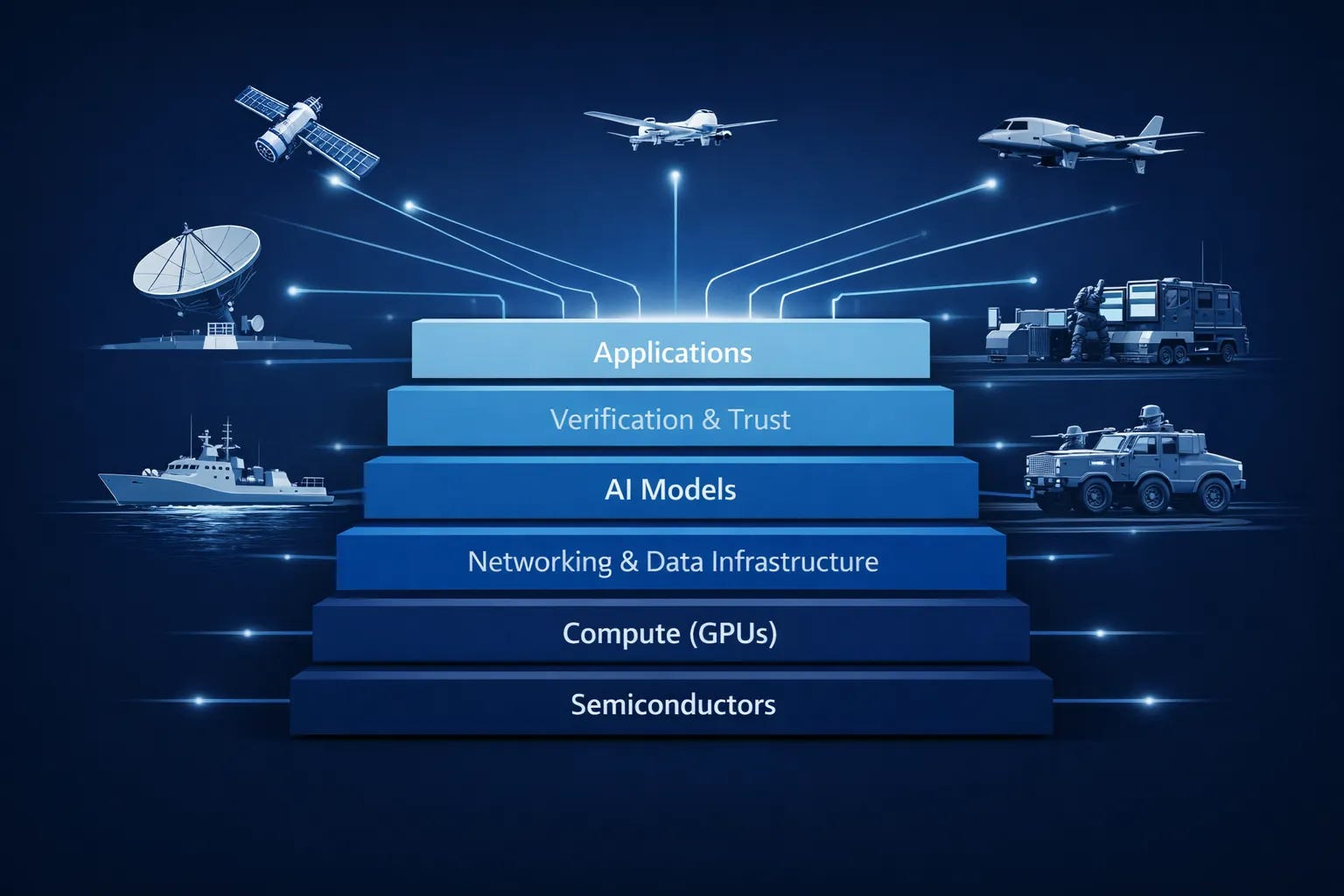
The AI Stack is Quietly Becoming the Next Defense Tech Stack
A wave of venture funding is pouring into the infrastructure, networking, and verification layers that future military AI systems will depend on.
It’s easy to say ‘AI is hot’.
In fact, just about everybody in deep tech has been saying that for the past 3+ years. Venture capital has flooded the sector, crowding out funding for other parts of the startup ecosystem.
The public markets tell a similar story. AI-linked firms now dominate tech indices, increasing capital concentration risks for investors.
The surge of capital has also created a second-order effect: intense competition among venture firms is forcing investors to settle for smaller and smaller ownership stakes in the most promising companies.
A closer look at fundraising announcements from the past week provides a clearer picture of how the AI market is taking shape — and where investors believe the real constraints remain.
AI Infrastructure
We’ve seen the emergence of the infrastructure layer as a critical constraint and opportunity in AI.
Investors are suddenly betting big on the physical and digital backbone of the AI ecosystem. Infrastructure firms like Nscale and Vast Data raised massive multi-billion-dollar rounds this week alone.
Investors are pouring billions into an optimization stack spanning compute, networking, memory architecture, and GPU kernel optimization.
Scarcity remains in this key infrastructure stack and those companies working here likely will continue to provide the largest returns for investors.
Of particular note within this infrastructure layer, we saw a micro-trend this week in a networking startups like Nexthop AI, Eridu, Xscape Photonics, and Qdrant.
This suggests AI training clusters are becoming sufficiently large that network topology and interconnect speed are emerging as major performance differentiators. What’s more, these clusters now resemble the same distributed sensing and processing networks that are emerging in military systems as the Joint Force moves toward distributed sensing, targeting, and decision-making across domains. In many ways, the commercial AI industry is quietly building the networking architecture, on which future military kill chains will rely.
Verification and Reliability
Trust, explainability, reliability, and correctness remain unresolved challenges in AI systems. Until these challenges are solved, hallucinations, vulnerabilities, and adversarial manipulation will limit the usefulness of AI systems. This is particularly critical in defense applications, where hallucinations or adversarial manipulation can have catastrophic consequences.
Several companies saw significant raises this week for their work tackling trust and correctness in AI outputs like Axiom Math, Axiomatic AI, and Axiom Trust (noticing a trend in how we name these companies? It’s almost as bad as the Tolkien-inspired defense tech companies).
Additionally, companies like Augur, Armadin, and Kai raised to improve security / cybersecurity to prevent adversaries from poisoning or manipulating AI.
All of this suggests the emergence of what might be called a ‘trust stack’ for AI.
Right now, AI cannot guarantee correctness. And, while that’s fine for chatbots, it’s not acceptable if we’re using AI for missile targeting, designing aircraft, controlling financial systems, or other critical missions.
As AI moves into critical systems, we need formal verification layers.
The Application Layer
Compare these large clusters of infrastructure and trust-focused companies with the relatively small number of application startups that raised funding this week. Yes, application layer companies still appear like Replit, Sandbar, and Lyzr AI. Application deals appear fewer, smaller, and more specialized. This suggests growing investor belief that the application layer will commoditize quickly. As a result, the capital is shifting deeper into the stack.
Strategic Takeaways
Three trends stand out from this week’s funding announcements.
First, AI infrastructure is emerging as the primary bottleneck — and therefore the primary investment opportunity. Investors are increasingly directing capital toward the compute, networking, and memory layers that determine how quickly AI systems can scale.
Second, trust and verification are becoming critical enabling technologies. As AI systems move into defense, finance, and industrial applications, reliability will become just as important as capability.
Third, the application layer appears increasingly commoditized. While new AI applications continue to emerge, venture capital is beginning to shift deeper into the stack where durable technical advantages are harder to replicate.
Taken together, these trends suggest that the AI economy is evolving into a layered industrial system, where infrastructure and reliability technologies may ultimately capture far more value than the applications built on top of them.
For the defense community, these developments are particularly important.
Modern military operations increasingly rely on AI-enabled sensing, targeting, and decision support systems. But those capabilities ultimately depend on the same underlying layers now attracting massive venture investment: compute infrastructure, networking architecture, and trustworthy AI systems.
In other words, the commercial AI stack is quietly becoming part of the future defense industrial base.
Understanding where capital is flowing today provides insight into which technologies will shape tomorrow’s battlefield — and which parts of the future defense industrial base are already being built in the commercial sector.
Operation Epic Fury
Trump threatens NATO, if they don’t clean up his mess (FT)
U.S. bombs key Iranian island amid oil concerns (TG)
Pentagon reportedly deploying another Amphibious Ready Group and Marine Expeditionary Unit (ARG/MEU) to the Middle East (MT)
Israel expands strikes in Beirut, deepening a humanitarian crisis in Lebanon (F24)
Pentagon sees Iran war lasting up to six weeks (BBG)
Drone hits Dubai airport as Iran targets commerce (WP)
Trump accuses Iran of using AI to spread disinformation (RT)
News Headlines
Tech billionaires may be growing less altruistic (TC)
U.S. Army signs $20B contract with Anduril (DS)
Pakistan says it thwarted Afghan Taliban drone attacks (TDP)
Fed to hold interest rates steady as Iran War scrambles the economic outlook (BBG)
Italy explores return of nuclear power after 40 years as energy costs hit (BBG)
Myanmar’s parliament meets for first time in 5 years with military controlling most seats (RT)
Polish PM worried about growing Euroskepticism in country emboldened by MAGA and the Kremlin (POL)
Far-left and far-right parties gain momentum in French municipal elections, throwing mainstream parties into quandary (FT)
Gen Xers and Millenials are dying earlier and faster than preceding generations (SA)
Quantum Tech
Researchers demonstrate quantum teleportation between two quantum dots (STD)
Quantum infrastructure demands overwhelm current capabilities, threatening U.S. supremacy in the quantum race (HST)
Britain’s Chancellor of the Exchequer pledges $1.33B for British quantum computers (FT)
Infleqtion delivers UK’s only operational 100-qubit QC system (BW)
AI / ML
Deepfakes have entered the midterm elections (CNN)
Companies are racing to build AI-enabled robot soldiers (TM)
Pentagon CTO Emil Michael claimed Anthropic‘s Claude models could ‘pollute’ defense supply chain based on built-in policy frameworks (CNBC)
Ukraine opens battlefield AI data to allies in world-first move (MT)
Pentagon adds custom Gemini-integrated AI agent building tool to GenAI.mil suite (DS)
‘Radical acceleration’ in AI military targeting raises oversight fears (F24)
Tech giants continue to tap debt markets to fund AI and cloud expansion (RT)
Musk fired more xAI co-founders, says company must be ‘rebuilt’ (WSJ)
Semiconductors / Chips
U.S. Commerce Department withdraws planned rule on AI chip exports (RT)
U.S. chip sfound in Russia’s new Izdeliye-30 cruise missile used in strike on Kharkiv (U24)
Intel shareholder says board gave stake to US to avoid Trump criticism (FT)
China’s ByteDance gets access to top Nvidia AI chips (WSJ)
Meta is developing 4 new chips to power its AI and recommendation systems (WI)
Extended, Augmented, Virtual, and Mixed Reality
Meta faces lawsuit claiming smart glasses sent private footage to overseas reviewers (R2)
Elbit to develop helmet-mounted U.S. soldier mission command system (TDP)
Deal Flow
VC
Nvidia agreed to invest in Mira Murati’s AI startup Thinking Machines Lab; the startup was in talks to raise a round at a $50B valuation (TC)
UK AI infrastructure startup Nscale raised a $2B Series C at a $14.6B valuation led by Aker and 8090 Industries (TC)
Israeli AI infrastructure firm Vast Data raised $1B at a $30B valuation (CT)
Chinese AI startup Moonshot AI is seeking to raise $1B at an $18B valuation (BBG)
Advanced Machine Intelligence, the AI startup of ex-Meta AI chief Yann LeCun, raised a $1B seed round at a $3.50B pre-money valuation co-led by Cathay Innovation, Greycroft, Hiro Capital, HV Capital, and Bezos Expeditions (WI)
Nexthop AI, an AI networking startup, raised a $500M Series B at a $4.2B valuation led by Lightspeed Venture Partners and a16z (BW)
Vibe coding startup Replit, a, raised a $400M Series D at a $9B valuation led by Georgian Partners (TFN)
Axiom Math raised a $200M round with participation from Menlo Ventures, Greylock, and Madrona to build AI systems that verify computer code using mathematical proofs (PU)
Eridu, an AI networking hardware startup, raised a $200M Series A led by Socratic Partners, John Doerr, and Matter Venture Partners (BW)
Armadin, an autonomous AI cybersecurity startup, raised $190M combined seed and Series A funding led by Accel (TC)
AI cybersecurity startup Kai raised a $125M funding round led by Evolution Equity Partners (WSJ)
Vector search engine Qdrant raised a $50M Series B led by AVP (SA)
Xscape Photonics, a developer of photonic interconnects for AI data centers, raised an additional $37M Series A round led by Addition (BW)
AI wearables startup Sandbar raised a $23M Series A led by Adjacent and Kindred Ventures for an AI note-taking ring (TC)
Standard Kernel, an AI GPU-kernel optimization startup, raised a $20M seed round led by Jump Capital (PU)
Axiomatic AI, an engineering-focused AI verification startup, raised an $18M seed round led by Engine Ventures (BW)
Femtum, a laser solutions startup for advanced chip manufacturing, raised a $16M Series A led by BDC (PM)
Security AI startup Augur raised a $15M seed round led by Plural (PU)
Enterprise AI agent startup Lyzr AI raised a $14.5M Series A+ led by Accenture (TFN)
Unreasonable Labs, an AI scientific discovery startup, raised a $13.5M round led by Playground Global (BW)
AI-native trust administrator Axiom Trust raised an $11.8M round led by Lightspeed Venture Partners (PU)
Zymtrace, a GPU-optimization platform, raised an $8.5M seed round led by Venture Guides and a $3.7M pre-seed led by Fly Ventures and Mango Capital (CBZ)
PE / M&A / Exits
BE Semiconductor Industries is fielding take-private interest on surging demand for advanced chip packaging (RT)
Nvidia agreed to invest $2B in $24B-listed AI infrastructure firm Nebius (WSJ)
Meta agreed to acquire viral AI bot-only social media platform Moltbook (AT)
OpenAI agreed to acquire AI security startup Promptfoo (TC)
Exciting Opportunities
DARPA is issuing a Quantum Benchmarking Initiative topic to solicit innovative approaches addressing challenges related to quantum computing (SAM)
The Federal Aviation Administration is looking for data, approaches, and insights from industry regarding capabilities and readiness to support the transition of the National Airspace System, its supporting Air Traffic Control infrastructures, and business systems to post-quantum cryptography (SAM)
Editor’s Picks
Travis Kalanick has dropped a ‘manifesto‘ on his return to startups--this time robotics.
University of Southern California researchers have found that LLMs are reducing cognitive diversity, making humans think and write more similarly to one another.
Lighter Side



Keep Building,
BOF