
The Ghost Armada Problem
Unmanned mass will not deliver maritime advantage until the Navy builds the edge intelligence, resilient networks, and distributed command architectures to turn sensing into decisions

JD Kristenson writes Rudder Orders, a biweekly-ish newsletter on maritime power, defense technology, and AI. Subscribe on LinkedIn for concise analysis of the systems, industrial capacity, and command choices shaping the future fleet.
Everyone is counting unmanned ships; almost no one is asking who will make sense of what they see.
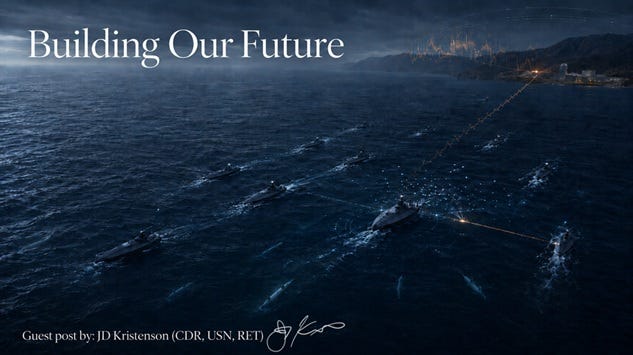
A recent prize-winning Proceedings essay, Naval Intelligence in the Age of Autonomy, AI, and Attritable Mass, gave this risk a memorable name: the “ghost armada.” The Navy could field an impressive force of unmanned surface and undersea vessels and yet fail to build the intelligence architecture required to turn their collection into decisions.
That would create maritime mass without maritime advantage.
The hidden work performed by a crew
The intelligence architecture of the manned fleet rests on an assumption we rarely state: every ship carries its own context engine.
Sailors do more than operate sensors. They recognize that a contact does not fit the “pattern of life.” They compare an electronic emission with what happened on the midwatch yesterday. They notice bad weather, merchant traffic, equipment behavior, and adversary deception. Then they decide what matters, what can wait, and what must be reported now.*
The shore does not receive everything the ship sees. It receives information already filtered, interpreted, and prioritized by people at the tactical edge.
Remove the crew and that work does not disappear; it becomes an architectural requirement.
This is why simply connecting more unmanned vessels to existing intelligence centers will not work. A force operating across thousands of miles, above and below the sea, will create more data than centralized staffs can absorb. In a denied, degraded, intermittent, or limited-bandwidth environment, much of that data may never reach them at all.
The answer is not a bigger pipe to shore. The answer is to redesign where understanding occurs.
Intelligence must move to the edge
First, unmanned systems must interpret before they transmit. They should not treat every radar return, acoustic detection, image, or electronic emission as equally worthy of scarce bandwidth. Edge systems must correlate inputs, detect changes, assign confidence, preserve provenance, and send the most decision-relevant information first.
That does not require every vessel to possess human-level judgment. It requires each node to perform bounded, mission-specific interpretation and to know when its confidence is too low. The goal is not to eliminate the analyst. The goal is to ensure the analyst sees the contact that matters rather than drowning in the collection that does not.
Second, the architecture must degrade gracefully. A useful formulation from Proceedings is “autonomy with networking,” not autonomy that depends on the network. A vessel or local cluster should be able to continue its mission, protect itself, collaborate within reach, and preserve information when the connection to higher command disappears.
When communications return, the system should reconcile what changed, share what it learned, and accept new guidance without requiring a complete reset.
Command by intent, not continuous control
The hardest question is not where the compute sits. It is where decision authority sits.
The manned-fleet model assumes a commanding officer and watch team are present to resolve ambiguity. An unmanned force operating under electronic attack cannot depend on continuous permission from a distant headquarters. Before communications fail, commanders must define the mission, priorities, boundaries, and actions that subordinates and subordinate systems may take.
Authority must be distributed in layers. The individual vehicle handles navigation, self-protection, and tightly bounded mission tasks. A local cluster fuses observations and reallocates collection. A manned afloat node or forward command element handles higher-consequence judgments. Shore provides campaign context, retasking, and oversight when the network allows.
This is command by intent translated into software and data architecture.
“Human in the loop” is not a sufficient answer. A human placed into an autonomous workflow without visibility, authority, or time to intervene is not exercising control. The architecture must specify which decisions require approval, which may be delegated, what evidence the decision-maker receives, and what the system does when no answer can arrive.
Trust must be engineered
Distributed authority only works if commanders trust what the system reports and can reconstruct what it did. That requires data pedigree, confidence measures, auditable decision logs, clear permissions, and continuous testing against deception and failure.
Trust is not faith in a model. It is the ability to understand a system’s limits, observe its behavior, and hold its actions accountable. Naval thinkers have long argued that human-machine teaming requires command-and-control architectures that preserve human command; more recent frameworks likewise place edge AI and explicit human oversight at the center of unmanned operations.
This problem is not unique to the Navy. The Navy is about to learn what industry already has. Industrial companies routinely buy sensors and models, then discover that nobody designed the layer that turns detection into a call, assigns responsibility, or closes the loop.
Data collection is not operational capability. Neither is an unmanned hull.
The decisive maritime platform of the next war may not be a ship at all. It may be the distributed system that connects sensing, interpretation, communications, trust, and command across crewed and uncrewed forces.
If we build that system, unmanned mass can become combat power. If we do not, we will have built a ghost armada: everywhere at sea, seeing everything, and understanding too little in time to matter.
*Editor’s note: An excellent example of this sensemaking that happens on the bridge comes from the Royal Navy’s HMS Gloucester during the Persian Gulf War. Near the end of the war, the Iraqi military fired a Silkworm antiship cruise missile at the British Type 42 destroyer.
The Silkworm followed a track closely replicating that of American A-6 aircraft and Lt. Cdr. Michael Riley had only 90 seconds to assess the tracks from the Gloucester’s various radars (Types 992, 1022, and 909 radars) and make a shoot / no-shoot determination.
We would refer the reader to Gary Klein’s book Sources of Power, example 4.2 (pg 61 in the 20th anniversary edition) for a full telling of the incident and Riley’s decision making process.
Epic Fury
Trump considering ‘massive attack’ on Iran as Tehran labels U.K. ‘accomplice’ to America (CNBC)
Yemeni Houthis attack Red Sea tankers; Trump says he’ll hold Iran responsible for Houthi actions (BBG)
IRGC commanders, missiles flow into Yemen to support Houthis as Iran seeks to broaden war’s scope (RT)
U.S.-Iran peace talks aren’t likely as attacks widen (BBG)
Brent crude again hits $100 per barrel on Red Sea, Iran supply threats (BBG)
Iran strikes on CIA facilities prompt questions about possible Russian role (RT)
Pentagon offers conflicting explanations for obfuscating casualty reports online (NYT)
Senate GOP blocks measure House-approved measure to end Iran war, despite concerns about lack of endgame (TH)
U.K. ‘ready to defend itself’ after Iranian threat over U.S. bases (TG)
News Headlines
Poland warns Russia could launch false flag op using captured Ukrainian drones (U24)
Trump approves landmark Saudi nuclear deal, contingent on the Kingdom joining Abraham Accords (CNBC)
Trump imposes double-digit tariffs on dozens of countries as 10% levies are set to expire (AP)
Israelis fear Saudi nuclear deal could ignite Mideast arms race (RT)
Ukraine gets a new military chief: Mykhailo Drapatyi (AP)
Venezuela’s Maduro in court for pre-trial hearing in U.S. drug-trafficking case (AP)
Defense & Dual-Use Technologies
U.S. Navy is 2 years behind on hypersonic missile installation on Zumwalt destroyers (DN)
House adopts ‘Bigg’s amendment’ to slightly cut defense budget if Pentagon fails audit (TH)
House passes $1.15T defense bill in near party-line vote (NPR)
Threat Tech
Taiwan: Chinese vessel activity jumps raising fears for Pacific supply routes (RT)
U.S.: 3x China-linked spy sites in Cuba are monitoring American military activity (MP)
China’s PLA showcases new airburst munition Steel Rain (MP)
Russia is providing China with training, intelligence, and advanced technology (TE)
U.K. ‘ethical’ fintech boss tried to do deals with Russian arms dealer (FT)
E.U. naval mission will now begin targeting Russian shadow tankers in the Indian Ocean (DN)
Satellite images show Russia’s militarization of the Arctic (BI)
Foreign Defense Tech
Australia demonstrates new hybrid air defense weapon in live-fire trial (IE)
Greece to buy $3B Achilles Shield missile defense system from Israel (TOI)
Israel’s IAI unveils Hypnosis system for confusing enemy drone swarms (JP)
U.K.’s BAE enters uncrewed fighter competition with Brontanax (DN)
Defense Industry
Boeing still on track to deliver two new Air Force One aircraft in 2028, as costs run billions over budget (BD)
Pentagon awards $2B to Hanwa Philly Shipyard to build 2 missile-tracking ships (DN)
Lockheed announces cheaper Patriot interceptor missiles (WSJ)
Pentagon awards Oracle $7B agreement for consolidated software tools, licenses (DS)
Saronic picks Brownsville, TX for $3B Port Alpha shipyard (MT)
X-Bow seeks to tackle cost curve with sub-$100K drone interceptor (MT)
Autonomous Systems
Doodle Labs eyes U.S., European production sites as demand soars for jam-resistant drones (DN)
Lockheed‘s Morfius X-Rotor built to fry 50 enemy drones in one flight (DN)
Marines turn to Allen Control Systems‘ AI-powered Bullfrog as drone threats expand (MT)
Finance & Deal Flow
Funds
Lockheed Martin has announced it will invest $100M in European defense firms, as it opens new office in London (EUS)
VC
Battery materials startup Sila raised $300M in a financing led by Atreides Management and Sutter Hill Ventures (TC)
Cathedral, an AI-driver offensive and defensive cyber operations company founded by DOGE alumni, raised a whopping $160M seed round at a $1.4B valuation led by a16z and Sequoia to acquire a data center to power its cyber ops (RT)
Twenty, a VC-backed cyber warfare startup, raised an additional $30M at a $1.2B valuation from Khosla Venture (PRN)
Elio raised a $21M round led by Innovation Endeavors and Xora to build sensors designed for artificial intelligence rather than the human eye (BW)
Israel-based ASIO raised a $15M seed round led by Protego Ventures to provide tactical intelligence systems, C2 platforms, and jam-resistant navigation (JP)
Bluecore Energy, a maritime floating nuclear power startup, raised a $10M round led by Slauson & Co. (TC)
VXB raised a $4M seed round led by Dautnless Ventures to accelerate the development of advanced aerospace components (VXB)
PE / M&A / Exits / Other
Critical mineral refining company Nth Cycle will merge with Kensington Capital Acquisition at a $585M valuation (PRN)
Innovative Aerosystems acquired Aydin Displays for $24.5M in an all-cash deal (BW)
Exciting Opportunities
Britain’s Royal Military Academy Sandhurst is creating a new defense technology program and seeking its first director (BP)
DIU is looking for ground robots en masse (DIU)
Editor’s Picks
Donald Trump Jr’s ‘America first’ investment firm 1789 Capital is on a hot streak. 200% returns is not too bad (of course, considering the insider knowledge).
Palantir FDE Kevin McCarville offers lessons on drone warfare from Iraq and Syria for the Army.
Lighter Side



Keep Building,
BOF
 | A guest post by
|