

Vice Adm. David Lewis (Ret.) formerly directed the Defense Contract Management Agency and commanded the Navy’s Space and Naval Warfare Systems Command. His career spans naval operations, information warfare, shipbuilding, and defense acquisitions. He is a Professor of Practice at the Naval Postgraduate School and shares his writings on his Substack.
Inspired by Building Our Future post “Responsibility without Control” and Paul Scharre’s CNAS paper “The AGI Moment: Strategies and Recommendations for an Uncertain Future.”
A business value chain is the full sequence of internal activities a company performs to design, produce, market, deliver, and support its product or service. Conceived by Michael Porter, this framework divides business operations into two main categories: primary activities that directly build and sell the product and support activities that make the primary functions more efficient. See Harvard Business School Online Guide.
Google AI Overview
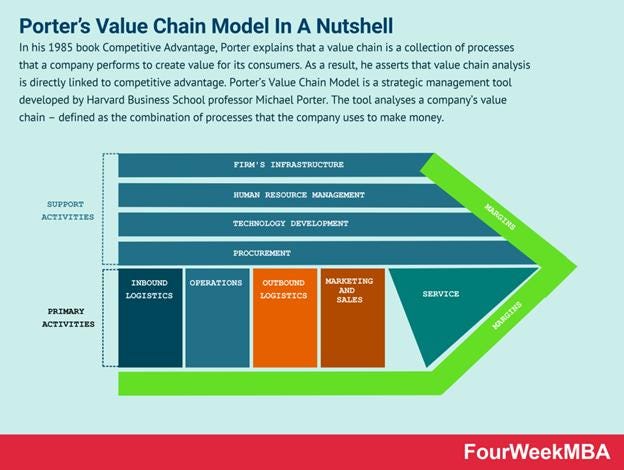
At the end of this business value chain is the creation of customer value. The value chain can be perfectly planned and executed, but if there is no customer, or the customer doesn’t like the product, the entire system fails.
I hypothesize a “Killing Value Chain” in warfare. The act of killing, like stabbing an enemy in the chest with a knife, is analogous to the business’s “primary activities.” It involves immediate, personal contact with the killing: killing organizations, killing tactics, and the battlefield supply chain. Above that sits the killing value chain’s support activities, the primary focus of the two articles that inspired this post: command and control, weapons development, strategy, training, and leadership.
That suggests a three-thread killing value chain. Simpler than the business chain but similarly structured:
1. Physical-Effects Chain: produces the lethal effect.
2. Decision-and-Command Chain: determines whether, why, where, and against whom force is used.
3. Development-and-Governance Chain: creates the weapon, its decision architecture, operating constraints, doctrine, and accountability mechanisms.
For the Killing Value Chain, the business objective of creating customer value is analogous to Clausewitz’s famous quote, “war is the continuation of politics by other means,” by the Prussian soldier and writer Carl von Clausewitz. The killing value chain must produce a desired political objective to be of “value.” Well-executed killing that fails to meet the political objective is a failure no less than a well-structured business that makes a product that doesn’t sell.
Together, this forms the Killing Value Chain.
As in the business chain, touching the product is a primary function that best sits at the base of the value chain. Thus, the three-thread Killing Value Chain operates inside Clausewitz’s larger Political Value System. That flips the above structure, creating a nested formulation:
Development and Governance (a support activity).
Decision and Command (a support activity).
Physical Effects (a primary activity).
All living within a Political Value System.
The Political Value System begins with political purpose, employs the three threads of the Killing Value Chain, integrates its effects with diplomacy, information, economics, and governance as needed, and judges whether the resulting condition justifies the costs.
Graphically, this produces a simpler model than Porter’s:
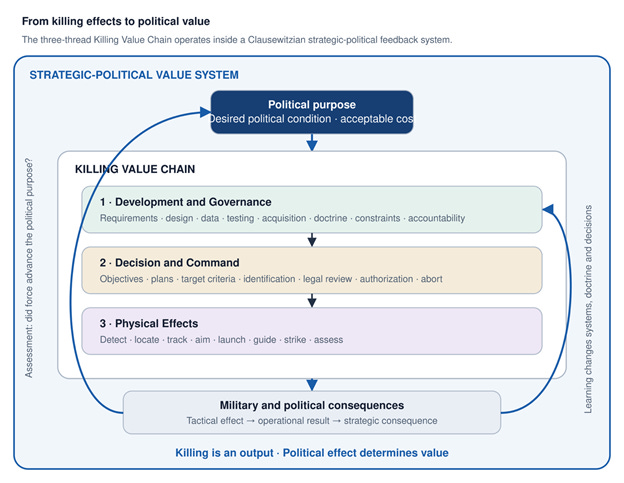
This model works for Pharaonic chariot warfare against the Hittites, Roman Legions operating in Thrace, Nelson’s fleet at Trafalgar, and the bloodied poppy fields of Flanders. Humans killed; barons, dukes, and generals led armies, and kings and parliaments found the money and the people to field them. All operated under the rubric that war was politics by another means. Ramesses II didn’t defeat the Hittites at Kadesh, but he won the war because of that battle. Nelson defeated Napoleon’s Combined Fleet at Trafalgar, but Imperial France wasn’t conquered for another decade. Political results didn’t necessarily correlate with an effective Killing Value Chain. Exactly as in business. New Coke, anyone?
Now we introduce machines. Crossbows, cannons, and machine guns kill at range, and often impersonally. The grape shot from a cannon kills indiscriminately. No human picked which soldiers (or civilians) were to die; Commanders decided where to put the cannon and what to shoot at. Humans pointed and fired the weapons; physics and chance did the rest. Human planning, human intent, machine execution. Machine killing handled the Physical Effects layer while humans worked at the Decision and Command layer. As the machines became more sophisticated, humans ceded more of the killing value chain. B-17 Bombers had a measured CEP (Circular Error Probable) of 1,200 feet, even though the Norden bombsight advertised a 75-foot CEP. On the test range, the Norden performed as advertised; over Germany, in ambient air temperatures of 35 to 60 degrees below zero, in clouds of Flak and screaming Messerschmitts, after a four-to-five-hour transit, it didn’t. That difference resides in the Development and Governance layer. Commanders planned bombing raids based on a 75-foot CEP but executed them at the 1,200-foot performance level. That did not achieve the desired political results. Allied bombing didn’t defeat Germany any more than the London Blitz demoralized Londoners.
The purpose of the killing value chain is not killing. Its purpose is to create military effects that contribute to achieving a desired political condition. Killing that cannot be connected to that condition does not create value, no matter how technologically sophisticated, strategically admirable, or tactically efficient it may be.

Now we introduce Artificial Intelligence. As the referenced articles clearly state, AI can operate within all three threads. As with machine killing, AI can dramatically improve the scope, efficiency, and effectiveness of the Killing Value Chain. Millions of Ukrainian UAVs have stopped Russia’s military in its tracks, and they are rapidly depopulating the adult male population of the Russian State. An ex-Soviet republic has brilliantly defeated one of the world’s greatest military powers using machine warfare and, lately, artificial intelligence. AI was not there initially, but it is clearly driving the astounding success of Ukrainian defenses. In Somalia, and later in Iraq and Afghanistan, Project Maven’s proto-AI architecture enabled significant and effective counter-insurgency operations. In Gaza, AI did much of the physical killing and enabled much of the decision-and-command thread that decided where and how that killing was to occur.
Like machine war, AI war has driven human involvement up the killing value chain. As with machines, however, it has not absolved humans of the responsibility for what the killing value chain is doing. Nor has it changed the “value creation” aspect of warfighting: achieving a desired political objective. We have likely not yet begun to explore AI’s role in deciding what that value-creation objective might be. “If we bomb every German city and factory to rubble, will they surrender?” Expected answer: “Yes.” Achieved answer: “No.” It turns out that surrender (and Allied victory) in Germany had to involve Germans looking down the barrel of a gun held by an enemy soldier standing in their living room. Machines (B-17s and B-24s) could not do that. That requirement hasn’t changed since Rome defeated Carthage in the Punic Wars.
Artificial intelligence extends this movement up the Killing Value Chain because it can perform both cognitive and mechanical tasks. It differs from earlier machine tools in speed, scale, opacity, adaptability, replication, and its ability to shape the information on which human judgment depends.
AI can fuse intelligence, identify correlations, nominate targets, rank threats, generate courses of action, recommend weapons, estimate collateral effects, and accelerate authorization in the decision and command domain. This may be more consequential than releasing autonomous weapons. A system need not fire a weapon to exercise decisive killing influence. If commanders act because they believe an AI-enabled system has validated the evidence, the system has acquired epistemic authority: authority over what people believe to be true.
This creates a distinction between formal human authority and meaningful human judgment. A commander may legally approve a strike while being intellectually downstream of AI-generated conclusions that no one has the time, staffing, access, or confidence to understand or challenge. The Charge of the Light Brigade in 1854 did not require AI to be a disastrous order. AI can generate that kind of order as easily, and for the same reasons. A nominal human in the loop provides no meaningful control when the system determines what the human sees, how it displays uncertainty, which options it presents, and how quickly a decision must be made.
AI can also generate software, design components, curate or synthesize data, run simulations, conduct testing, identify vulnerabilities, update models, and recommend doctrinal changes in development and governance. AI therefore becomes part of the lethal system architecture. Engineers and acquisition officials make moral choices when they decide what the system can perceive, which attributes count as evidence, how confidence is displayed, when human review is required, what triggers an abort, and what happens when communications are lost. A successful Project Maven computer program in Somalia didn’t know anything about insurgents when it went to Iraq or tanks when it went to Ukraine, until a human taught it.
The resulting accountability problem is that responsibility can become fragmented among data providers, developers, testers, system integrators, intelligence personnel, lawyers, operators, commanders, contractors, acquisition officials, and political leaders. Everyone retains a piece of responsibility while no one person sees their role as the author of an eventual lethal outcome. “Will no one rid me of that troublesome priest?”
Conclusion
The Killing Value Chain consists of three interacting threads: Physical Effects, Decision and Command, and Development and Governance. Together they create authorized lethal effects. They operate inside a Political Value System that defines the purpose of the Killing Value Chain and determines whether the consequences justify the costs.
AI enters all three threads. It can help weapons perceive and act, help commanders understand and decide, and help institutions design the systems and rules that govern both. It can also accelerate error, conceal uncertainty, fragment accountability, and give its own generated conclusions more authority than their evidence warrants.
The defining challenge is therefore not merely keeping a human at the final point of weapon release. It is preserving meaningful human judgment and traceable human responsibility throughout the creation, authorization, execution, assessment, and adaptation of lethal force. Killing is an output. Political effect determines value. Responsibility remains human.
Epic Fury
U.K. probes possible Iran link after foiling suspected terror plot at base hosting U.S. forces supporting Epic Fury (WSJ)
Eight U.S. Marines reportedly injured in Iranian cruise-missile attack on ship in Strait of Hormuz (NBC)
U.S. disputes IRGC claim that it seized a Navy Mk-18 Mod 2 Kingfish undersea drone (JP)
More than 100,000 personnel now use Maven Smart System, which helped U.S. forces strike 13,000 targets in 38 days during Epic Fury (DS)
Defense & Policy
Ambassador David Perdue claims Trump axed Xi whether China wanted to buy U.S. weapons (TG)
Trump weighs diesel-export ban as global supply crunch worsens (CNBC)
AI / ML
Trump recasts AI as ‘super intelligence’ in U.N. speech (DO)
Trump floats creating an ‘AI Force’ as a new military service (NG)
U.S. appeals court upholds Pentagon’s blacklist of Anthropic as Trump hosts Amodei (AP)
Ukraine opens AI drone-training platform built on combat data to U.K. companies (DN)
TRANSCOM turns to AI to make military logistics harder to predict and attack (DS)
Dassault flight-tests AI algorithms aboard Rafale fighter as France considers future upgrades (RT)
Thales in advanced talks with NATO countries over AI-powered C2 software (DN)
Altman and Amodei call for global cooperation on AI safety (BBG)
Typesafe AI‘s Jev trades chat for fast, structured decisions--and takes aim at larger models (BBG)
Quantum Tech
Chinese team says compact quantum magnetometer detected underground train and buried object in field tests (QI)
Researchers demonstrate non-Abelian anyon operations needed for universal quantum computing (SD)
Japan switches on its first full-stack room-temperature QC as team targets 10,000 qubits (LS)
Infleqtion claims 30 entangled logical qubits using 80 physical qubits on its Sqale QC (INF)
Lockheed launches Quantum Innovation Center for national-security applicatons (IE)
CGI Federal, DLA, UT Knoxville launch QC study for defense logistics (QI)
Babcock and Arqit demonstrate quantum-safe data link to deployed mortar system (QCR)
Compute (Data Centers, Chips, etc)
AWS becomes first cloud provider approved for NATO RESTRICTED workloads across all member states (DO)
U.S. trails in memory chips--and tariffs could deepen the disadvantage (WSJ)
Google set to launch experimental orbital data-center satellite this week (NYT)
China’s Alibaba unveils new AI chip and ambitious model roadmap (ABC)
Huawei unveils new AI-compute cluster and accelerated chip roadmap as China works around U.S. semiconductor restrictions (AP)
China weighs allowing ByteDance, Alibaba to buy new Nvidia chips (RT)
Texas halts new data-center permits pending audit of grid, water, and infrastructure demands (RT)
Deal Flow
VC
AI training data startup Snorkel AI raised a $350M Series E at a $3.5B valuation led by Insight Partners and S32 (TC)
Parallax emerged from stealth with $117M across seed and Series A rounds to develop 3D-printed gas turbines for AI data centers (WSJ)
AI training-data startup micro1 raised a $100M Series B at a $4B valuation (DR)
On-premises AI infrastructure provider Go.AI raised an $85M Series A led by Updata Partners (BW)
AI-agent data startup Firecrawl raised a $75M Series B led by Smash Capital (SA)
Agentic-AI security startup Outerlimit raised a $16M pre-seed round from AlbionVC, Evolution Equity Partners, and Crane Venture Partners (PU)
Physical AI data and simulation startup Midcentury raised a $15M seed round (DR)
Chip-scale quantum sensing company Mesa Quantum raised an $11.8M funding round led by Playground Global to commercialize GPS-independent timing and navigation (BW)
M&A / Strategic Transactions / Exits
Solidigm, the NAND memory unit of Korean chip darling SK Hynix, is considering raising $15B at a $150B valuation a U.S. IPO (RT)
AI neocloud Nscale files for U.S. IPO, seeking up to $3B at a $30B valuation (IBD)
Nvidia will buy an additional $1.5B of shares of SoftBank-backed data center firm SB Energy at a 10% discount to its upcoming U.S. IPO (BBG)
Lighter Side
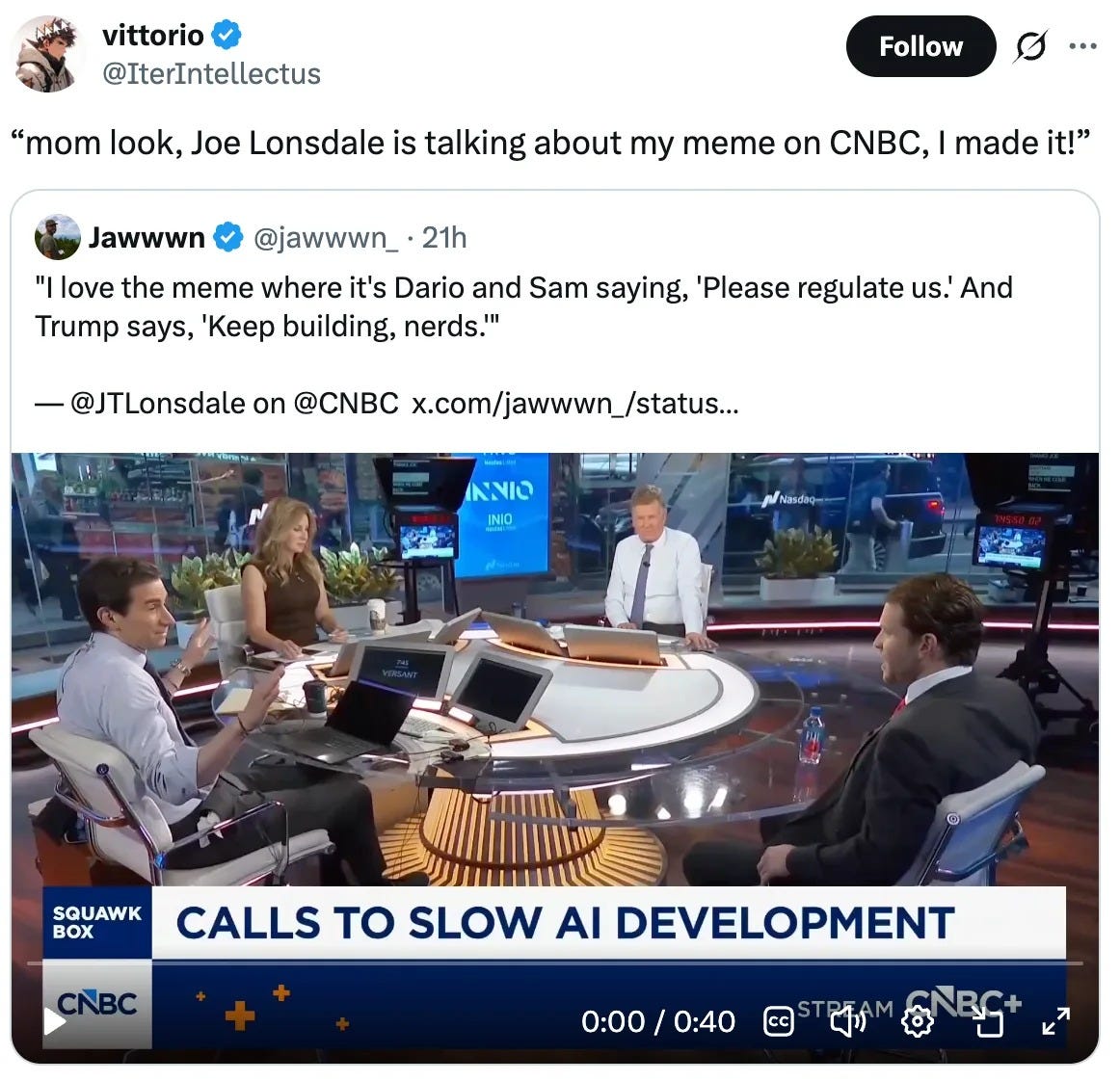
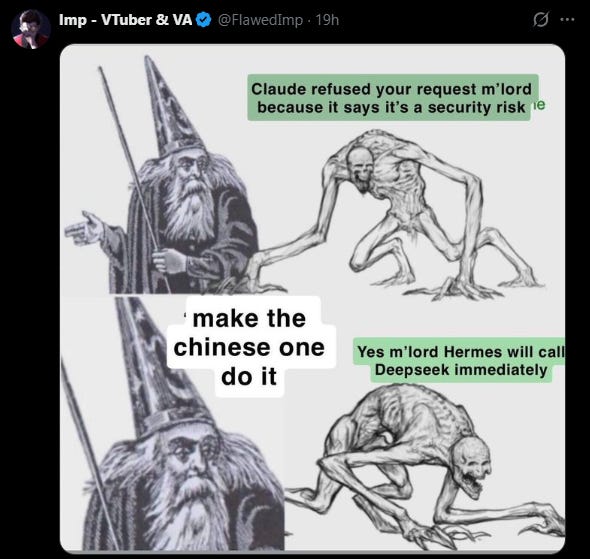
Keep Building,
BOF
An unsettling article for a couple of reasons, including the lack of an actual graphic with a "chain" to portray the discussion (assuming one finds Porter's Value Chain graphic sufficient -- I do not), the apparent conflation of "counter-insurgency" for "counter-terrorism" in the discussion of Project Maven, and the complete lack of discussion about the need for a clear, achievable political objective to measure the "value chain" against.
I came away unsure what point(s) the author was attempting to make, and frustrated by the logic leaps between actions/events and outcomes throughout the article.