
Fragmentation and Friction
Political violence at home, stalemate abroad, and AI decoupling signal a world defined less by resolution--and more by persistent strain
Domestic Violence
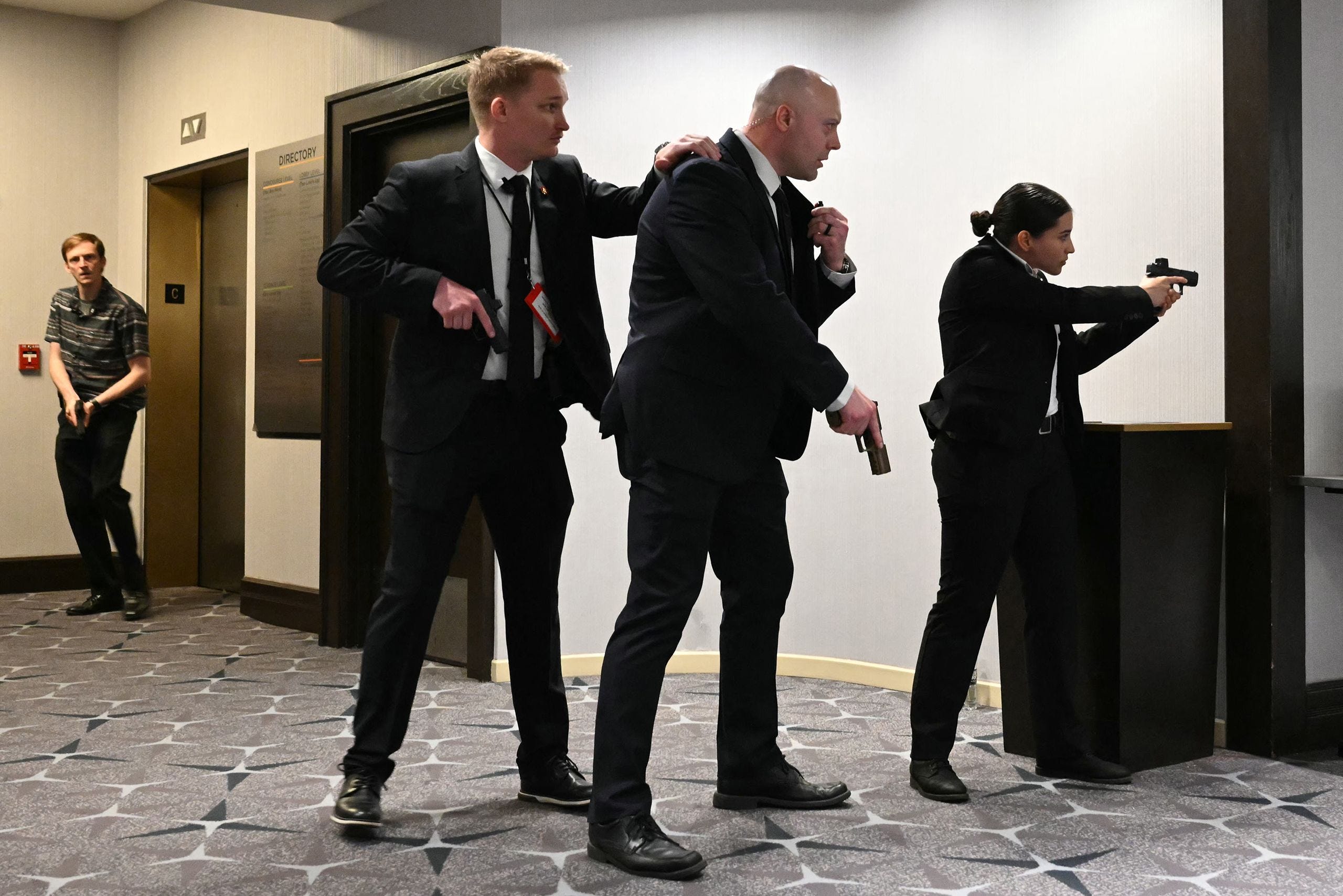
Security experts are debating the adequacy and effectiveness of security during the White House Correspondents’ Dinner—held at the Washington Hilton—after 31-year-old Cole Tomas Allen opened fire outside the ballroom and attempted to charge past security. The incident highlights the heightened tensions and increased political violence in the country.
BoF Disclaimer: We wholeheartedly reject the use of political violence as a means or end.
BoF Analysis: We anticipate seeing continued elevated risk of political violence given the normalization of political violence rhetoric, erosion of institutional trust, and increased access to weapons and amplification mechanisms (social media, network effects). We anticipate continued elevation in lone-actor and small-cell political violence. While conditions for organized, large-scale rebellion don not exist in the United States today, the broader West is not uniformly insulated from that risk.
Heightened Tensions in the Middle East
In the Middle East, the U.S. and Iran remain locked in their standoff, although Iran has provided a proposal to the U.S. that excludes mention of nuclear programs. The U.S. military conducted a helicopter interdiction of the M/V Sevan in the Arabian Sea. The Sevan is one of 19 sanctioned vessels comprising Iran’s ‘Shadow Fleet’.


Despite this interdiction, Iran has succeeded in running the blockade repeatedly, exporting more than 4 million barrels of oil—worth nearly half a billion dollars.
BoF Analysis: Neither side appears incentivized to terminate the conflict quickly. Instead, we are entering a phase of managed confrontation—characterized by intermittent escalation, economic friction, and incomplete enforcement regimes. Iran’s ability to move oil despite interdictions highlights the growing limits of maritime control and sanctions enforcement, a trend that will have cascading effects across global energy markets.
Global Competition in Technology
In AI, China’s DeepSeek released its V4 open source model. According to Artificial Analysis, DeepSeek V4 is back among the leading open weights models, second only to Kimi K2.6. Their scoring puts it roughly on-par with Claude Sonnet 4.6; however, it still lags behind the U.S.’ most advanced closed weight models like GPT 5.5, Claude Opus 4.7, and Gemini 3.1. Based on this, the reaction to DeepSeek V4’s release was much more muted than last year’s DeepSeek-R1 model release.

Nevertheless, China continues to close the gap in open-weight models, even as the United States maintains an edge in frontier, closed systems. Nevertheless, this once more highlights the closing technological gap and the cost curve inversion in competition.
Another AI-related development from China emerged this morning. Meta announced in January of this year, its $2B acquisition of AI startup Manus. The PRC has stepped in, vetoing the transaction and forcing Meta to unwind the deal. Chinese authorities have barred the acquisition over national security and technology export grounds, as it seeks to implement national sovereignty over AI. This is not an isolated decision, but represents an early indicator of a broader, structural decoupling in advanced technologies.
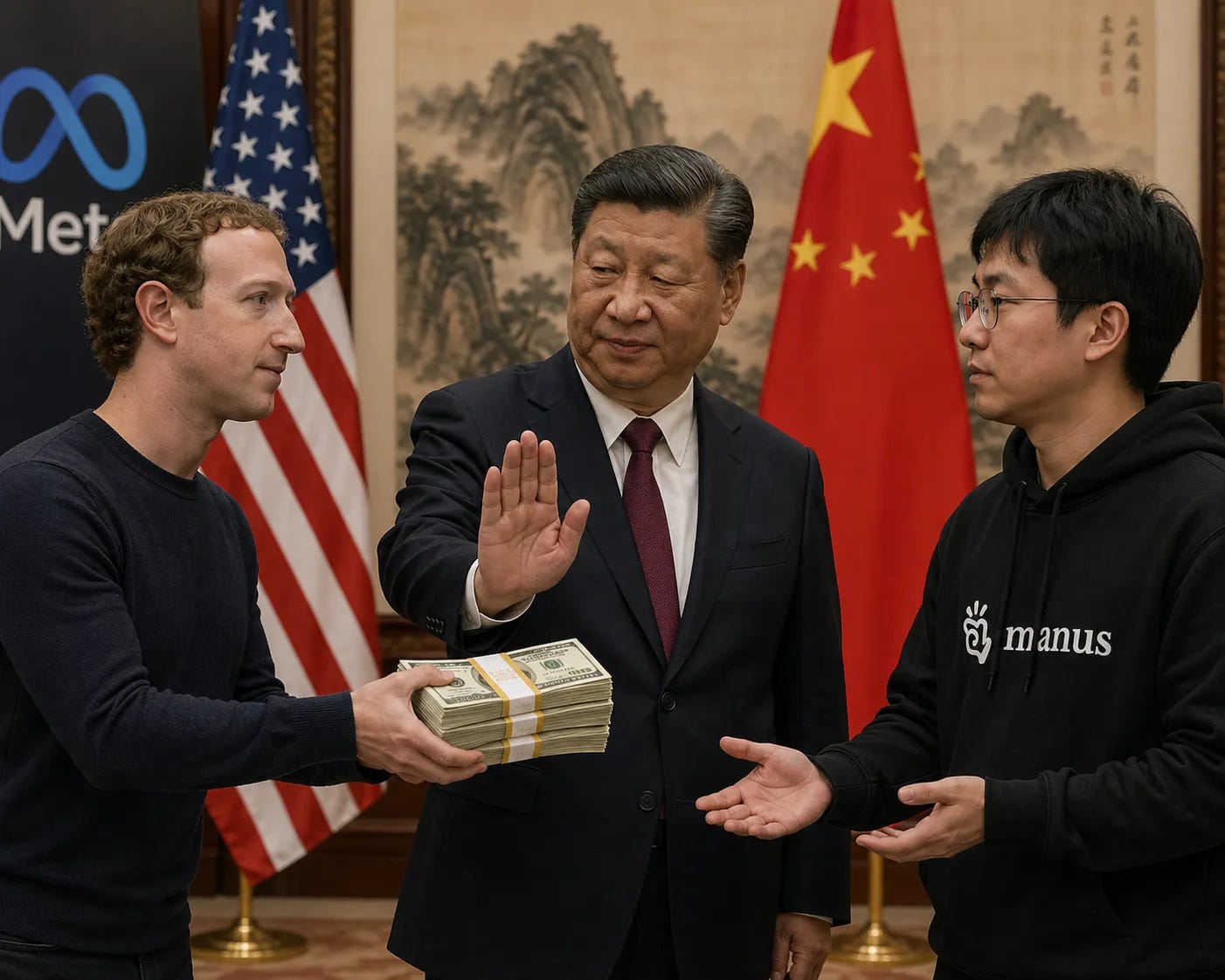
AI is becoming a sovereign capability. Capital, code, and compute will no longer flow freely across borders.
BoF Analysis: We expect this to be but one early example of tech decoupling that China will pursue as they seek to increase competition with the United States. Western investors and companies will find it increasingly difficult to conduct business in China in a way that provides benefits to the West. Applications, models, semiconductors, and all the way down to the supply chains will increasingly become contested.
Across domestic security, regional conflict, and technological competition, the same pattern is emerging: fragmentation, friction, and the erosion of centralized control.
Operation Epic Fury
U.S. intercepts sanctioned merchant vessel in Arabian Sea (RT)
Iranian foreign minister to meet with Putin; blames U.S. for talks breakdown (BBG)
Iran has succeeded in exporting 4M+ barrels of oil despite U.S. blockade (GN)
Iran’s military command threatens response if U.S. blockade continues (WSJ)
News Headlines
Gunman opens fire outside ballroom hosting White House Correspondents’ Dinner (AP)
DOJ dropped its criminal investigation into Fed chairman Jerome Powell (CNBC)
China will curb US investment in tech companies after Meta deal (BBG)
Supreme Court to consider constitutionality of geofencing warrants (NPR)
King Charles III and Queen Camilla of the United Kingdom set to arrive for State Visit in the United States today (AlJ)
Quantum Tech
QC companies are in a race to go public (WSJ)
Scientists propose early-warning system for quantum supply chain as China tightens minerals grip (QI)
New study suggests next-gen atomic clocks could test whether time can exist in quantum superposition (QI)
IonQ details ‘walking cat’ architecture for fault-tolerant QC (HPC)
QCi launches NeuraWave photonic platform for edge AI inference (QCR)
Stretching and squeezing diamond opens new path for ultra-precise quantum sensors (PHYS)
AI / ML
Trump says U.S. will get along with Anthropic after Pentagon spat (BBG)
AI bill would crack down on deepfake distribution and protect whistleblowers (CNBC)
Anthropic’s new Mythos model was hacked (BBG)
DeepSeek’s new model met with a resounding chorus of ‘meh’ (RT)
RAG precision tuning can quietly cut retrieval accuracy by 40%, putting agentic pipelines at risk (VB)
China orders unwinding of Meta‘s acquisition of AI startup (NYT)
China’s 360 hunts software flaws with AI, echoing Mythos approach (BBG)
Semiconductors / Chips
Meta partners with AWS on Graviton chips to power agentic AI (RT)
Nvidia has not yet sold its H200 AI chips to China: Lutnick (RT)
Google Cloud launches two new AI chips to compete with Nvidia (TC)
Deal Flow
Funds
Jeff Bezos’ physical AI startup Project Prometheus is in talks to raise a $10B round at a $38B valuation from JPMorgan and BlackRock (TFN)
OpenAI will commit $1.5B and PE firms TPG, Bain Capital, Advent, Brookfield, and Goanna Capital will invest a combined $4B in a $10B PE JV meant to increase adoption of OpenAI’s LLMs at PE-backed businesses (PU)
VC
Anthropic secondary shares are selling at a $1T valuation (TFN)
Google agreed to invest up to $40B in Anthropic (CNBC)
AI coding startup Cognition is in early talks to raise a round at a $25B valuation (TFN)
Chinese AI startup DeepSeek is in talks to raise funds at a $20B valuation to retain staff (RT)
CuspAI, a UK startup using AI for materials discovery, is in talks to raise an over $200M Series B at an over $1B validation (BBG)
Quantum Art extends Series A funding to $140M led by Bedford Ridge Capital (QI)
Finnish AI infrastructure company Verda (fka DataCrunch) raised $117M in funding led by Lifeline Ventures (PU)
Point2 Technology, an RF-based interconnect startup for AI data centers, raised a $76M Series B extension led by Maverick Silicon (BW)
Biossil, a biotech company reviving failed drug candidates using AI, raised $70M in funding from OpenAI, Founders Fund, and Staircase Ventures (LDS)
Orkes, an AI orchestration platform for agentic workflows, raised a $60M Series B led by AVP (BW)
NeoCognition, a research lab developing self-learning AI agents, raised a $40M seed round co-led by Cambium Capital and Walden Catalyst Ventures (TC)
ComfyUI, a node-based workflow startup for controlling diffusion-model outputs, raised a $30M round at a $500M valuation led by Craft Ventures (TC)
Collov, a visual AI startup, raised a $23M Series A led by Brightway Future Capital (PU)
Zapata Quantum, a quantum software platform, raised an oversubscribed $15M round led by Triatomic Capital (QI)
QMatter raised $1.2M led by 55 North to advance its quantum compression platform (QI)
PE / M&A / Exits
Chinese optical transceivers maker Eoptolink picked banks for a $3B Hong Kong listing (BBG)
AI chipmaker Forge Nano will merge with Archimedes Tech SPAC Partners II in a $1.6B deal (RT)
Canadian AI startup Cohere agreed to acquire German AI leader Aleph Alpha in a deal that includes a $600M investment from German retailer Schwarz Group (TC)
Chinese optical-computing company Lightelligence is set to raise $323M in an oversubscribed Hong Kong IPO priced at the top of a marketed range (BBG)
Quantinuum, the quantum computing unit of industrials conglomerate Honeywell, confidentially filed for an IPO (PRN)
Opportunities
NIST is looking for a high-speed arbitrary waveform generator that it can use to help create digital twin models of semiconductor processes (SAM)
The Army is looking for VR-based suicide prevention training programs (SAM)
Editor’s Picks
Reagan and Bush era White House staffer Douglas MacKinnon questions if America would be better without Congress.
Irene Zhang, Aqib Zakaria, and Jordan Schneider of CHINATALK break down why DeepSeek V4 isn’t impressing, despite its relatively strong performance.
Lighter Side

Keep Building,
BOF