
The Sovereign Stack
Military advantage increasingly belongs to nations that control compute, communications, memory, trust, and industrial infrastructure.

For more than a century, military—and largely national—power was measured in platforms.
Battleships. Tanks. Fighters. Aircraft carriers.
Nations competed to build bigger fleets, more advanced aircraft, and longer-range missiles. Analysts counted hulls, aircraft, and brigades because those were the visible expressions of national power. The assumption was straightforward: build better platforms and military superiority would follow.
Today, we have to question whether that logic still holds.
Today’s fighter aircraft is more than simply an airplane equipped with guns. It is a flying sensor fused into a cloud of data. A modern destroyer is as much a node in a distributed combat network as it is a warship carrying missiles. A satellite’s value is more than just its existence in orbit, extending to its participation in a constellation that provides communications, positioning, sensing, or even compute. Even a drone has become less important as an individual platform than as one member of a much larger ecosystem of software, autonomy, networking, electronic warfare, logistics, and manufacturing.
The platform has become an application running atop a larger operating system.
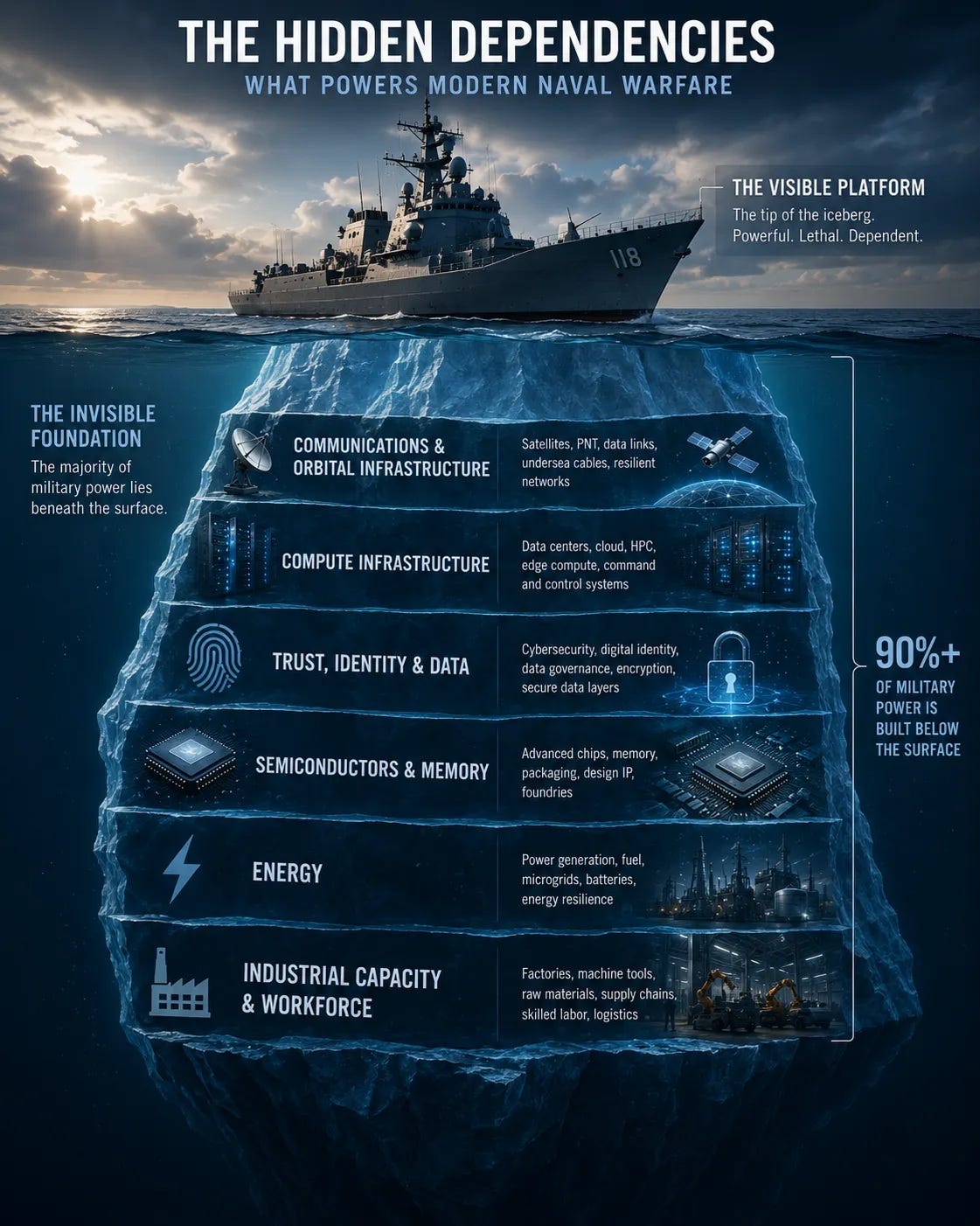
Its effectiveness increasingly depends upon a deeper layer of infrastructure that most discussions of military power rarely acknowledge.
That underlying architecture deserves its own name.
We call it the Sovereign Stack.
The Sovereign Stack is the collection of technological, industrial, and institutional layers that allow a nation to generate, process, move, protect, and act upon information at strategic scale. In addition to traditional defense platforms, it encompasses semiconductors, memory, compute, communications, positioning and timing, satellite infrastructure, cyber trust, AI models, energy, manufacturing, and the industrial capacity required to sustain them.
These layers rarely make headlines. They are expensive, technically complex, and often invisible to the public. Yet, increasingly they determine which nations can build effective military capabilities, which can sustain them in wartime, and which remain dependent upon someone else’s infrastructure.
Every additional application built atop a sovereign stack should make every other application more capable. Compute supports autonomous systems, intelligence analysis, logistics optimization, command and control, and cyber defense simultaneously. Communications networks strengthen every platform connected to them. Trusted identity systems enable secure data sharing across entire joint forces. Industrial manufacturing capacity accelerates the production of everything above it.
Once viewed through this lens, many of the most important technology stories of the past year stop looking like isolated developments. Instead, they appear as different manifestations of the same strategic competition: a race to own the layers beneath military power.
Platforms as Applications
To be clear, military platforms have not and will not become obsolete.
They remain the physical instruments through which military force is projected and political objectives are ultimately achieved. A nation cannot compel an adversary with compute alone. Aircraft still fly, ships still sail, and missiles still destroy targets. As T.R. Fehrenbach famously wrote in This Kind of War, ‘if war is to have any meaning at all, its purpose must be to establish control over peoples and territories, and ultimately, this can be done only as Alexander the Great did it, on the ground.” War remains a contest of wills requiring force through physical coercion.
What has changed is where those platforms derive their combat power.
Historically, a platform’s effectiveness depended largely on its own characteristics: armor thickness, engine performance, payload, speed, or range. While those attributes still matter, they no longer tell the whole story. Increasingly, the combat value of a platform is determined by its ability to access, contribute to, and exploit a much larger ecosystem of information.
A fighter without resilient communications is isolated. A drone without navigation, compute, or data links becomes little more than a model airplane. A destroyer disconnected from its sensors, satellites, and command network loses much of its operational advantage.
However, these platforms have all become increasingly dependent.
In that sense, platforms increasingly resemble applications running atop a much larger operating system. Just as software applications derive their capabilities from the operating system beneath them, military platforms increasingly derive their effectiveness from the infrastructure that enables them to sense, communicate, compute, coordinate, and adapt.
The competition, therefore, is no longer simply over who builds the best applications but is increasingly over who owns the operating system itself.
The Sovereign Stack
If platforms now function as applications, what constitutes the operating system?
The Sovereign Stack consists of the foundational layers upon which modern military capability increasingly depends.
At its base lies energy and industrial capacity—the ability to generate power, manufacture advanced systems, and sustain production during prolonged competition.
Above that sits the semiconductor ecosystem, advanced memory, and compute infrastructure that power everything from artificial intelligence to command-and-control systems.
Communications networks, resilient terrestrial and space-based connectivity, positioning and timing, and cyber trust allow information to move securely between distributed forces.
Data, AI models, software, and autonomous decision-support systems transform that information into operational advantage.
Only then do those capabilities manifest themselves through aircraft, ships, satellites, drones, missiles, and the countless other platforms that ultimately create physical effects on the battlefield.
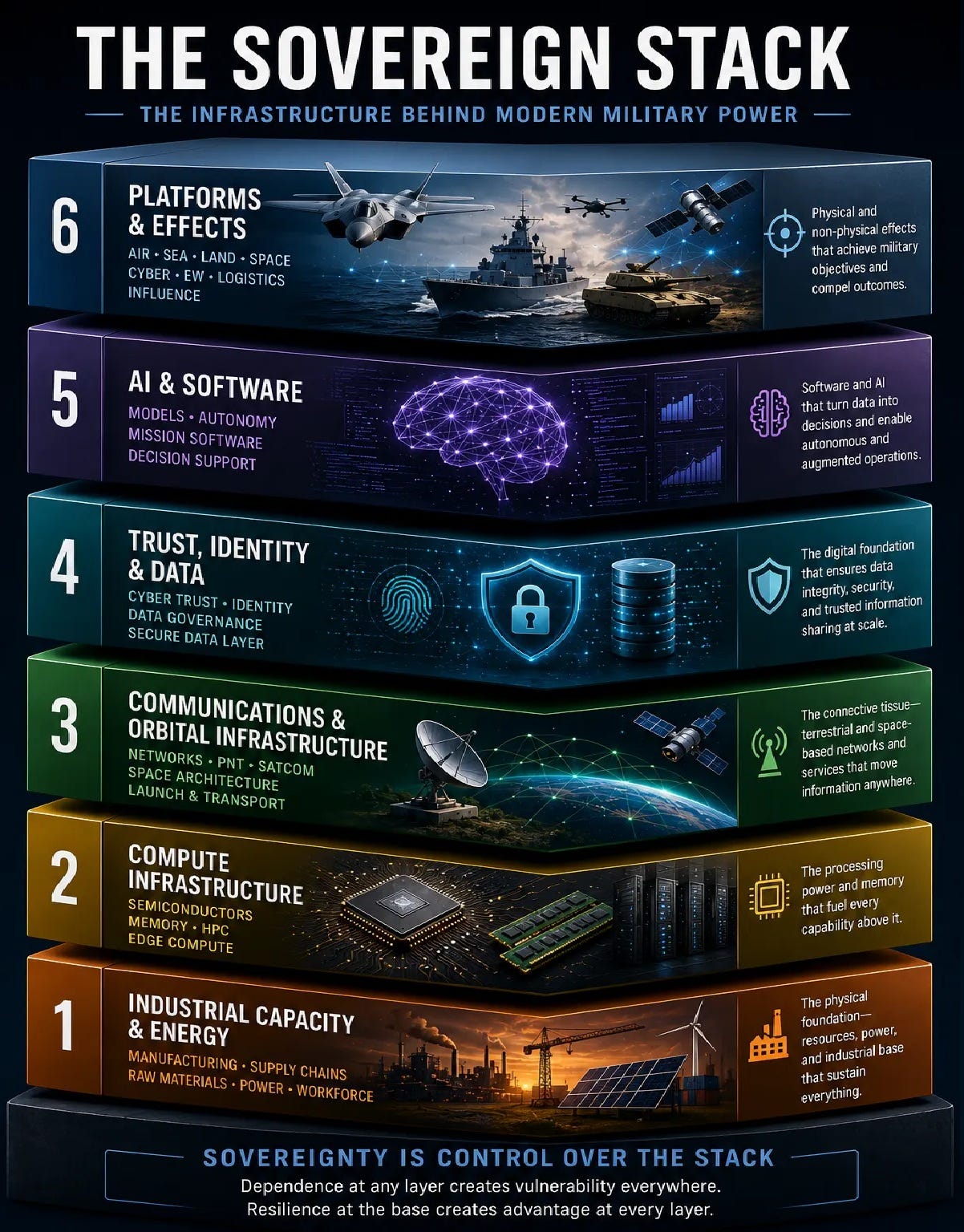
Each layer depends upon those beneath it. Weaknesses propagate and improvements compound, both upward.
This is what distinguishes a sovereign stack from a collection of individual technologies. It is not merely ownership of components. It is control over the interdependent architecture that allows those components to function together, adapt together, and endure under attack.
Military superiority increasingly emerges not from excellence in any single layer, but from the integration of all of them.
The Evidence Is Everywhere
Viewed independently, many of this year’s defense and technology stories appear unrelated. Together, though, they reveal an unmistakable pattern.
Artificial intelligence has exposed memory bandwidth—not processing power alone—as one of the industry’s most important constraints. The conversation has shifted beyond GPUs toward high-bandwidth memory, packaging, and data movement because compute without memory cannot scale.
Governments around the world have increasingly focused legislation and industrial policy on sovereign AI capabilities, semiconductor manufacturing, trusted infrastructure, and secure data rather than simply promoting AI applications. Policymakers have begun to recognize that dependence on foreign infrastructure creates massive, strategic vulnerabilities.
Japan’s proposal for a sovereign direct-to-device communications network reflects this logic. The goal of this endeavor is not to create another satellite constellation for its own sake but to develop national communications, independent of external providers.
Ukraine’s remarkable counter-UAS ecosystem similarly demonstrates that battlefield success no longer belongs to whichever side fields a superior drone. It belongs to the side that integrates sensors, electronic warfare, software, communications, manufacturing, logistics, and (critically) operational adaptation into a continuously evolving system.
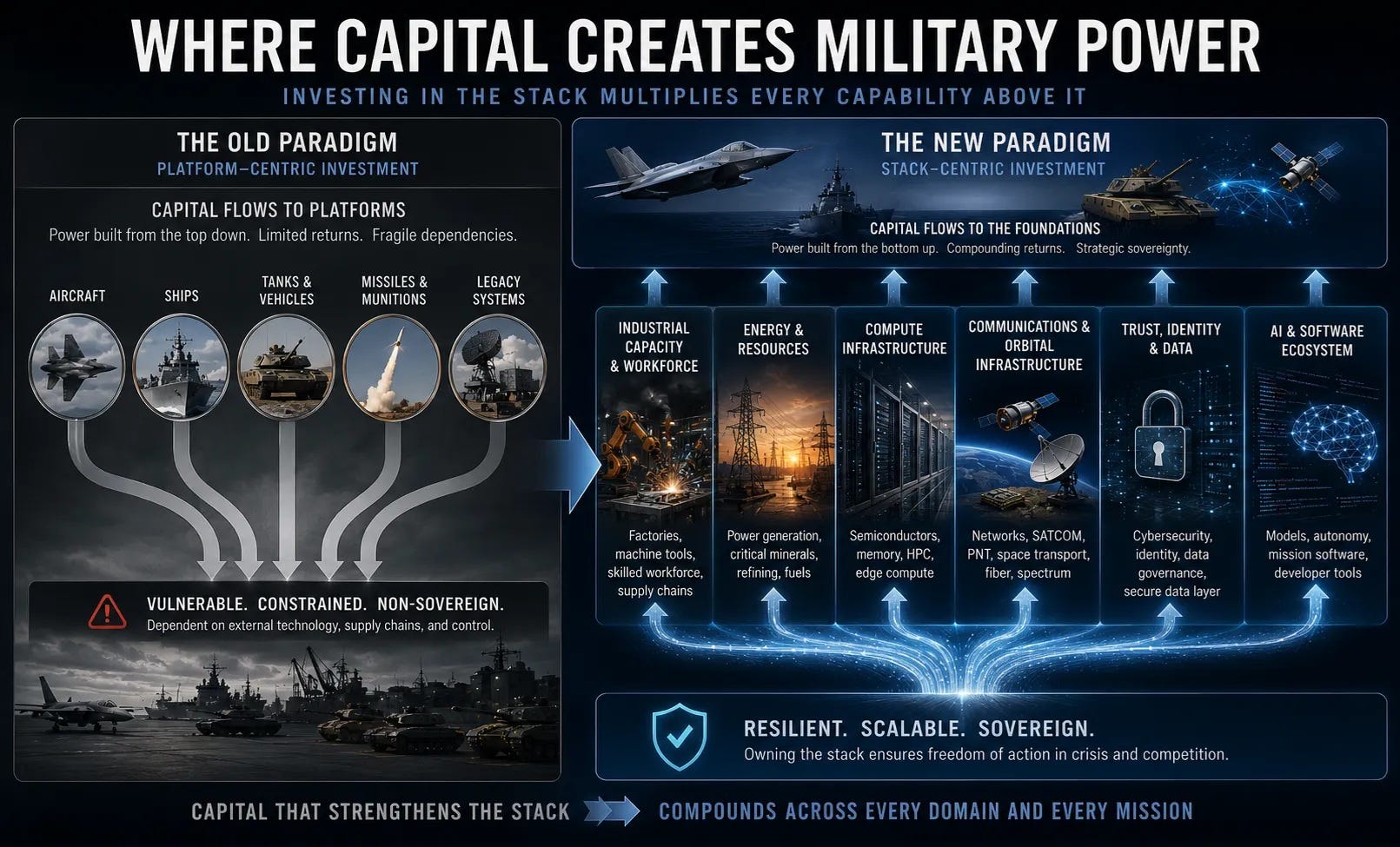
Private capital has reached many of the same conclusions. Investment is increasingly flowing toward power generation, advanced manufacturing, compute infrastructure, launch, communications, and resilient supply chains rather than isolated point solutions.
Different sectors, different countries and different technologies, all following the same strategic logic: control the stack, and the applications become more capable.
Depend upon someone else’s stack, and even exceptional applications inherit someone else’s constraints.
The Sovereignty Question
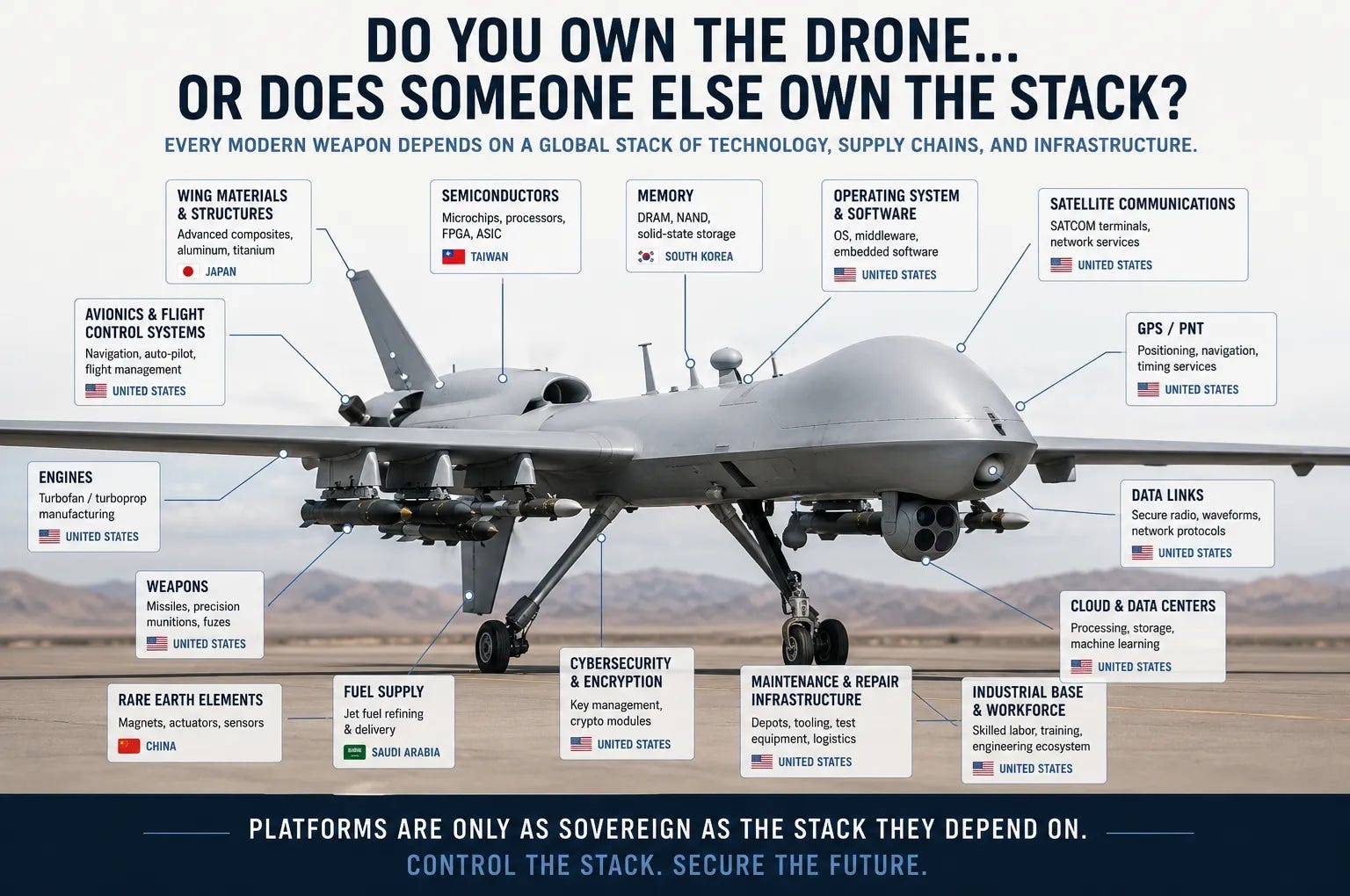
The Sovereign Stack raises a fundamental question extending beyond defense procurement: if military sovereignty increasingly depends upon controlling compute, communications, memory, trust, manufacturing, and the other foundational layers of the stack, how should governments evaluate the technologies they buy?
For decades, defense acquisition has largely focused on platforms and performance. Does the aircraft fly farther? Is the radar more sensitive? Can the missile strike with greater precision?
Now and increasingly, governments must also ask about ownership of compute, communications, data, memory, identity and trust architectures, manufacturing bases, and supply chains. Most importantly, they must ask who controls these layers during crisis.
A platform dependent on foreign semiconductors, commercial cloud providers, externally controlled communications networks, or fragile supply chains may deliver exceptional performance during peacetime while masking profound strategic dependencies during conflict.
Conversely, investments that appear less glamorous—a domestic semiconductor fab, resilient communications architecture, advanced packaging, tactical space infrastructure, secure identity systems, or distributed manufacturing capacity—may generate disproportionate strategic advantage because they strengthen every capability built upon them.
We’re not suggesting that the United States or any country should pursue autarky. No nation can or should produce every component itself.
Instead, we should pursue sovereignty: understanding which layers must remain under national control, which dependencies are acceptable, and where resilience must replace efficiency as the guiding principle. We must ensure that we own enough of the stack beneath our advanced military technology to trust it when it matters most.
A New Taxonomy of Defense Technology
The defense technology ecosystem has traditionally categorized companies by the products they build.
Oversimplifying, we’ve had aircraft builders like Boeing and Lockheed, shipbuilders like Huntington Ingalls, space companies like Kratos, AI companies like Palantir, autonomy companies like Anduril, and drone companies like AeroVironment.
Those categories remain useful for describing markets but are becoming less useful for understanding true strategic value.
The Sovereign Stack suggests a different way of evaluating defense technology companies—not by what they build, but by which layer of the stack they strengthen.
Some companies build foundational infrastructure: semiconductors, memory, compute, secure communications, launch systems, advanced manufacturing, trusted cloud environments, resilient networking, positioning and timing, or energy systems. Their products enable entire ecosystems of downstream capabilities.
Others build platforms. Aircraft, satellites, autonomous vehicles, ships, and ground systems translate the capabilities provided by the stack into physical military power.
Still others build applications: mission software, AI copilots, targeting algorithms, logistics platforms, digital engineering environments, and decision-support tools that leverage the capabilities already present beneath them.
None of these categories is inherently more important than the others. Modern warfare requires all three.
But, these categories create value differently.
Infrastructure compounds. Improvements at the foundation strengthen every platform and every application above it.
Platforms project power. They convert the capabilities of the stack into physical effects that achieve military objectives.
Applications optimize performance. They make platforms smarter, faster, more autonomous, and easier to employ.
Such a framework as this also suggests two useful questions for investors, corporate strategists, and policymakers.
Which companies are building genuinely sovereign capability?
Which companies are creating impressive products that ultimately depend upon someone else’s stack?
The answers may increasingly determine not only which companies outperform over the coming decade, but which nations retain genuine strategic autonomy in an era where military power is becoming inseparable from technological infrastructure.
The Sovereign Stack as Part of the Arsenal of the Future
For more than a century, military competition rewarded the nations that built the best platforms. The industrial age favored those that could produce more ships, more aircraft, more tanks, and more missiles than their rivals.
That competition remains but it is no longer the only one that matters.
Today, nations compete to build something far more fundamental: the technological and industrial operating systems upon which modern military power depends.
The arsenal of the future will still include aircraft, warships, satellites, drones, and missiles. Wars will continue to be fought in the physical world, and victory will still require the ability to impose costs upon an adversary and compel political outcomes. Yet those platforms will increasingly derive their effectiveness from something far less visible.
Beneath every modern military lies an intricate foundation of semiconductors, memory, compute, communications, positioning and timing, cyber trust, energy, manufacturing, logistics, and space infrastructure. Individually, each layer is important. Together, they form the Sovereign Stack.
This is ultimately why so many seemingly unrelated developments—from AI memory bottlenecks and sovereign communications networks to tactical space, advanced manufacturing, counter-UAS ecosystems, and industrial policy—are converging toward the same destination. They are all attempts to strengthen the layers beneath military power.
The nations that master these layers will not simply field better weapons. They will build militaries that are more resilient, more adaptive, more scalable, and ultimately more sovereign.
Those that neglect them may still possess impressive platforms. But in an era where military advantage increasingly depends upon the infrastructure beneath the platform, they risk discovering that the most consequential dependency was never the weapon itself. It was the stack upon which it depended.
Keep building,
Andrew Glenn
Founding Editor, Building our Future
News Headlines
Iran strikes vessel in Strait of Hormuz amid debate over ‘transit fees’ (CBS)
SecState Rubio tries to reassure Gulf allies on U.S.-Iran deal details (AlJ)
U.S., U.K., France, Germany raise alarms about Chinese patrols off eastern Taiwan (RT)
France seizes fifth Russian ‘shadow fleet’ tanker linked to Ukraine war (AlJ)
Taiwan drill simulates maritime blockade and quarantine by China forces (BBG)
China claims right to target people overseas with new ‘ethnic unity’ law (RT)
At least 188 killed, 1,500 injured by Venezuela earthquake as neighbors send rescue teams (AP)
Russian hawks urge Putin to escalate war, drop U.S. talks as Ukraine strikes deep (RT)
Former Nat’l Security Advisor John Bolton pleads guilty to mishandling classified (BBC)
Defense & Dual-Use Technologies
The Pentagon’s defense tech research infrastructure is ‘deteriorating’ (MT)
House panel advances $1.1T defense spending bill (TH)
Pentagon is flailing to spend $152B in reconciliation funding, risking loss of funds (BD)
The Army will open ranges for defense vendors to speed testing (DS)
Threat Tech
Alibaba sues Pentagon over blacklist designation (CBS)
Report alleges Missouri State University trained 1,500+ Chinese executives tied to China’s military industrial complex (FX)
Ukraine launches ‘TrophyLab’ platform to share captured Russian weapons with allies (DN)
Fiber-optic killer drone technology has arrived in southern Lebanon (DN)
Foreign Defense Tech
European defense tech is attracting a growing pool of homegrown capital, but 98% of startup rounds still come from outside the region (
Israel unveils laser weapon that can neutralize 30 drones per minute (TDP)
Italy rejects aid scheme that buys U.S. weapons for Ukraine’s defense (DN)
U.S. gives Philippines underwater vehicles as China feud persists (BBG)
Poland buys V-BAT drones to boost Baltic Sea naval operations (DN)
Romania orders Rheinmetall Skyranger 35 and Skynex air defense systems (TDP)
Ukraine’s barrages on Russia are missing a normal ingredient: ballistic missiles (NYT)
Ukraine is developing a balloon-launched, jam-resistant missile (DN)
Ukraine’s top strike-drone maker moves into ballistic missile defense (DN)
Defense Industry
The White House once more summons industry leaders over stockpile concerns (WSJ)
The Army will lease land on bases to companies for critical mineral production (WSJ)
China announces restrictions on procurement of goods manufactured by 46 U.S. companies including Lockheed, RTX, Boeing, & BAE (NPR)
Anduril eyes Nissan plant in Japan for expansion of drone, weapons production (RT)
Lockheed wins massive $35B+ contract to quadruple THAAD production (MT)
Beehive Industries expands 3D-printed jet engine production with $50M investment (TDP)
Seekr and SNC form strategic partnership to pursue AI-enabled defense technologies (PRN)
Autonomous Systems
Army looks to small ground robots as Ukraine war reshapes battlefield (SWJ)
Japan joins global craze to field interceptor drones (DN)
Philippines deploys U.S.-made Triton naval drones to scout for intruders (DN)
Finance & Deal Flow
Funds
Citigroup opens Baltic office to chase European defense spending boom (BBG)
Valor Equity Partners is raising at least $2.5B for its Fund VII; past investments include SpaceX and Anduril (TC)
Stratos Ventures, a newly formed Tel Aviv and Florida VC backing Israeli defense, resilience, infra, supply chain, and cybersecurity startups, raised more than $50M for Fund I (JP)
VC
Wars triggers $12B VC rush into defense tech (FT)
German drone maker Stark Defense raised a $571M round at a $3.7B valuation led by Sequoia and Founders Fund (BBG)
Longshot raised a $5M round led by South Park Commons to advance its ground-based launchers that use kinetic accelerators to propel payloads to hypersonic speeds (GNW)
PE / M&A / Exits / Other
Israel is considering U.S. IPOs of state-owned defense giants Israel Aerospace Industries and Rafael Advanced Defense Systems, which are valued at an estimated $34B and $20B respectively (BBG)
Germany will acquire a 40% stake in Franco-German tank maker KNDS from the founding family at a ~$20B valuation ahead of its IPO (RT)
Bain Capital to acquire Volkswagen‘s marine diesel engine unit for $8.45B (FT)
U.K. aerospace parts supplier Doncasters raised $920M in a U.S. IPO priced above a marketed range (RT)
Delivery drone startup Elroy Air is in advanced talks to go merge with Columbus Circle Capital Corp. II at a $1B valuation (BW)
Booz Allen to acquire Ultra defense tech unit for $720M (WT)
Code Metal acquires Signal Processing Technologies to expand its provable AI platform and establishing new Advanced RF Group (BW)
Shield AI completed its acquisition of defense simulation software maker Aechelon Technologies (DIE)
Standard Nuclear, a maker of fuel for nuclear reactors, filed for an IPO (BBG)
Debt
Venezuela is set to disclose a $240B debt pile to set the stage for the world’s largest restructuring (EN)
Editor’s Picks
William Treseder has curated the definitive list of Federal Sales and BD experts available to help early-stage defense and dual-use companies break into government.
Satellite imagery reveals the extent of damage from Iranian attacks on the U.S. Navy’s base in Bahrain, as concerns grow about lack of transparency from the Pentagon over the Iran war.
Air University‘s China Aerospace Studies Institute has released a report suggesting Chinese views of American stealth technologies are often misaligned to reality.
Lighter Side




Keep Building,
BOF
This post touches on a defence issue that I believe is critical, yet easily overlooked in current debates. We are not necessarily entering an era where the lessons and strengths of the past become obsolete. Rather, modern conflict seems to require a more nuanced lens—one that balances high-end capabilities with traditional mass. The future may not belong solely to next-generation tech, but to a complex blend ranging from large heavily armed warships, hypersonic missiles, 6th generation fighter jets, down to the renewed value of massed, inexpensive artillery alongside disposable one-way attack drones and automated armoured vehicles, wingman drones all integrated with far greater data connectivity and processing power than of even the recent past. An example I have followed closely that I feel is a folly is the cancellation of the Type 83 destroyer which should have been the tier 1 centrepiece of a hybrid naval force for the UK. Blending high and low tier military capabilities to form an extremely powerful military force when working together leveraging the strengths of each component part of the force.