
Eight Years to Urgency
Even as the military increasingly understands the future of war, it's still too slow to act.

Hi, I’m Andrew Glenn, Founder and Editor of Building Our Future. This edition of our newsletter explores three developments that, on the surface, appear to represent promising progress in defense innovation. Look more closely, however, and they reveal something deeply concerning about how slowly the U.S. military recognizes emerging requirements, translates foresight into action, and adapts for the future of warfare.
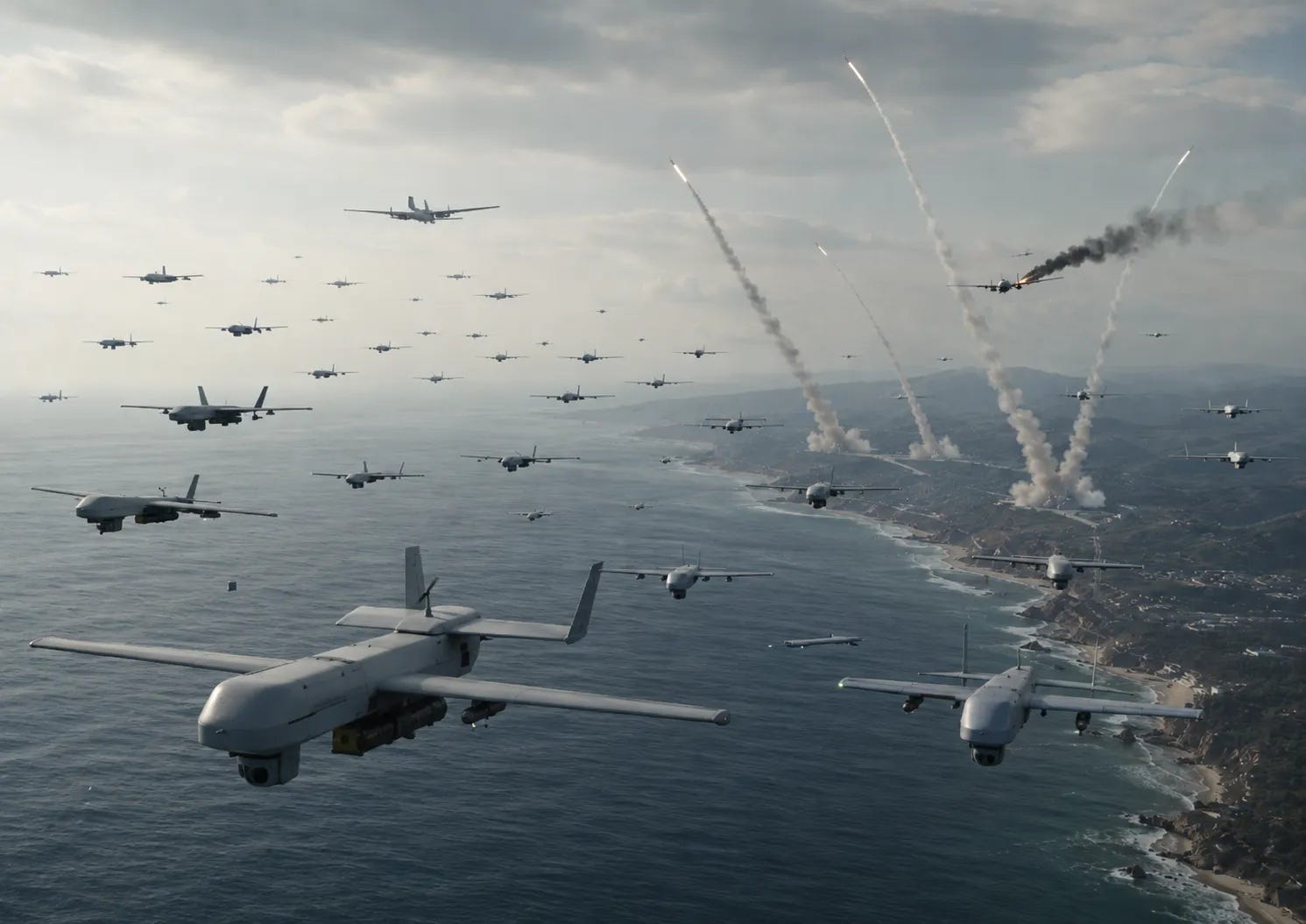
Three announcements this week offered encouraging evidence that the Pentagon is beginning to translate long-recognized requirements of modern warfare into actual programs.
The first was the authorization of multiyear procurement agreements for nearly 28,000 low-cost cruise missiles. The second was a Defense Innovation Unit (DIU) solicitation for massed, modular aircraft designed to impose persistent pressure on enemy air defenses. The third was another DIU solicitation seeking space-based power generation and power beaming.
Each of these reflects an important shift in how the Department thinks about future warfare. The military needs affordable weapons in enormous quantities. It needs risk-tolerant aircraft that can absorb losses while continuing to deliver kinetic and non-kinetic effects. And it needs new infrastructure in space that can provide power to satellites, unmanned systems, and forces operating in austere environments.
These are important problems to solve.
The concern is how long that translation has taken—and whether the Department can convert these concepts into operational capacity before the next war begins.
Affordable Mass, at an Unaffordable Price
The Pentagon announced this week that it had reached framework agreements with Anduril, CoAspire, and Zone 5 Technologies for multiyear production of their respective Barracuda, Rapidly Adaptable Affordable Cruise Missile, and Rusty Dagger systems. Once production ramps up, the Department expects the three companies to deliver approximately 8,000 missiles annually.
The multiyear structure is important. One of the defense industrial base’s most persistent complaints is that inconsistent annual demand makes investment in factories, tooling, suppliers, and personnel prohibitively risky. A five-year commitment gives manufacturers a reason to build capacity and gives their suppliers greater confidence that demand will persist long enough to justify expansion.
But predictable demand alone does not create affordable mass.
The five-year acquisition plan reportedly calls for $12.665 billion to procure 27,910 missiles. That implies an average cost of approximately $454,000 per weapon. While this is a significantly lower price point than for a JASSM-ER (~$2.4M) or Tomahawk (~$7.4M), it remains too expensive for a weapon intended to deliver truly attritable mass.
An affordable alternative should eventually cost an order of magnitude less than the exquisite weapon it complements or replaces. At nearly half a million dollars per missile, the Family of Affordable Mass Missiles, or FAMM, risks becoming another intermediate tier of expensive precision weapon rather than the transformative source of mass the Joint Force needs.
There are also reasons to question whether the current price reflects the lowest achievable production cost.
The agreement between Taiwan’s National Chung-Shan Institute of Science and Technology and Anduril reportedly places the cost of the Barracuda-500 at approximately $216,000 per unit. It is possible that the Air Force has requested additional requirements, modifications, or support elements, increasing the price of the weapon. And, it’s important to remember that the Barracuda is only one of three systems covered by the FAMM acquisition.
Nevertheless, a difference of more than 100 percent warrants explanation.
Even assuming that $216,000 represents manufacturing cost rather than sale price, historically reasonable defense-production margins would produce a price closer to $236,000 to $251,000. During the Second World War, average defense-industry profit margins declined from 16.2 percent in 1942 to 9.4 percent near the war’s end. Applying that range would still provide industry a reasonable return while allowing the government to purchase considerably more missiles.
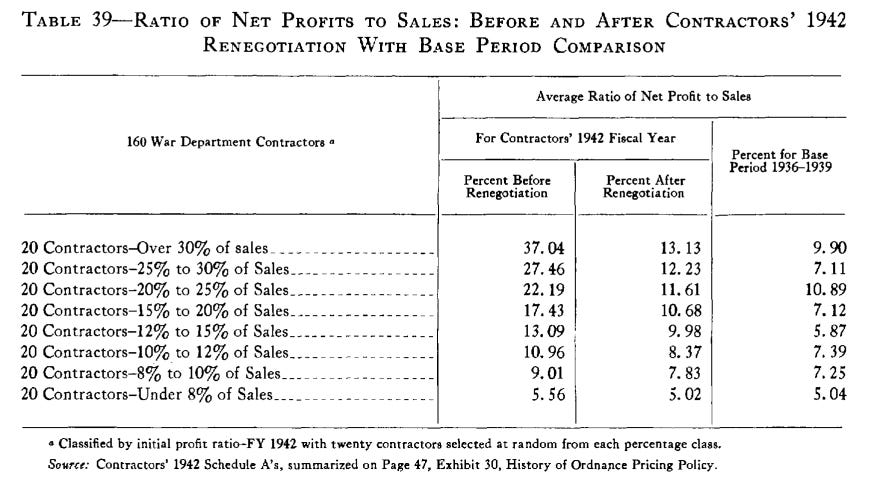
Even if the figures above are not directly comparable, the gap suggests that the government should require greater transparency into recurring production cost, nonrecurring development expense, and contractor margin.
Cost escalation presents an even greater long-term concern.
The JASSM-ER cost approximately $1.149 million in FY2017. The FY2027 price is approximately $2.4 million, an average increase of roughly 7.6 percent annually. A Tomahawk Block IV cost approximately $1.87 million in FY2017, while a Block V missile costs roughly $7.4 million in FY2027—although the newer missile includes meaningful capability improvements.
These weapons are not perfect comparisons, but what matters is the pattern. An initially affordable system accumulates additional sensors, communications, survivability features, software, and mission requirements (a process known as requirements creep). Each increment appears individually reasonable, but those increments add up over time, converting an inexpensive weapon into another exquisite one.
Applying a roughly 12 percent annual increase—the approximate average between the historical JASSM and Tomahawk rates—to the FAMM procurement illustrates the risk. If annual budgets remain fixed, the government would acquire approximately 20,600 missiles rather than 27,910. More than one-quarter of the planned arsenal would disappear through price escalation alone.

The multiyear agreement must, therefore, enforce affordability as it also works to stabilize demand.
That will require binding cost-reduction targets, rigorous configuration discipline, standardized components, modular open-system interfaces, supplier-level financing, production milestones tied to government investment, and transparent reporting on costs, delivery rates, and industrial bottlenecks.
Otherwise, the government may lock in predictable purchases while also locking in the cost escalation that keeps meaningful mass perpetually out of reach, or as some in the military might say, ‘one terrain feature away’.
The Missile Sponges Arrive
The second signal came from DIU’s new solicitation for Massed Modular Aircraft.
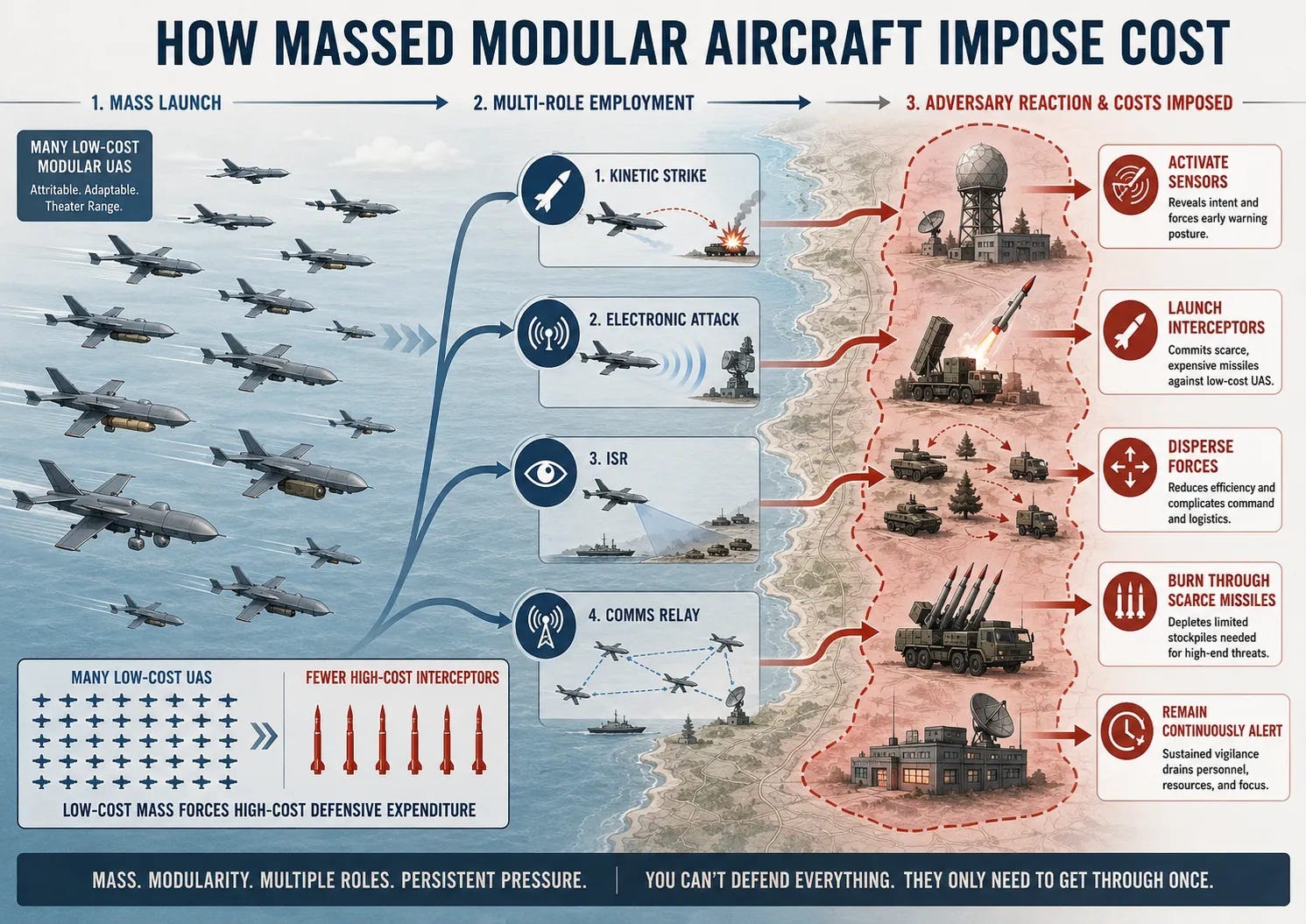
The problem statement is blunt. The Joint Force’s dependence on low-density aircraft costing more than $30 million each is unsustainable against layered air defenses. DIU is therefore seeking theater-range unmanned aircraft designed from the beginning with the expectation that some will be lost in combat.
The proposed aircraft would carry at least 2,800 pounds of payload, possess a combat radius of at least 2,300 nautical miles, and operate as part of a massed force. Individual aircraft could launch weapons, collect intelligence, conduct electronic warfare, or relay communications. Their persistent presence would force an adversary to remain on the defensive and expend costly surface-to-air missiles faster than they could be replaced.
In cruder terms, they would be missile sponges that could also fight.
This has been a central argument that we’ve made here at Building Our Future for about three years as part of a through-line running from attritable mass to long-range systems.
In fact, it’s been a part of conversations that I’ve personally had with the DIU while representing both private industry and offices within the Department, during that same time. Since early 2023, I’ve argued that the Joint Force needed inexpensive, long-range, modular aircraft that could generate persistent mass, carry multiple payload types, impose repeated dilemmas, and remain useful even when losses were expected.
These conversations generated enthusiasm that eventually collided with institutional reality: without a sufficiently mature military customer, validated demand signal, and plausible pathway to adoption, DIU did not convert the concept into a project.
Today, DIU is asking industry to build almost precisely the same capability that I—and others—have encouraged them to tackle for years.
The Department has recognized that future airpower cannot consist exclusively of exquisite aircraft operating from sanctuary. It also cannot consist exclusively of FPV drones and improvised tactical systems optimized for a very different operational environment than what the U.S. military is likely to face. Future airpower requires large numbers of adaptable systems that can enter threat envelopes, absorb losses, exhaust enemy defenses, and create opportunities for more valuable platforms.
Certainly, it’s better to be late than to never show. But in war, ‘late’ matters; it can be the difference between winning and losing, between life and death.
DIU is seeking a full-scale prototype flight test within 21 months of award and an initial operational capability in FY2031 consisting of only 20 mission-ready aircraft.
That means a requirement identified and raised in approximately 2023 may produce its first small operational formation eight years later.
The adversary is not obligated to wait.
Power Without Wires
The third signal is DIU’s Space Power Beaming solicitation.
Current satellites operate within severe power constraints. Solar arrays, batteries, thermal limits, and spacecraft mass place a ceiling on what a satellite can do and how long it can do it. Terrestrial forces face a related problem: modern sensors, communications equipment, unmanned systems, and computing infrastructure require growing amounts of power in places where conventional logistics may be contested or unavailable.
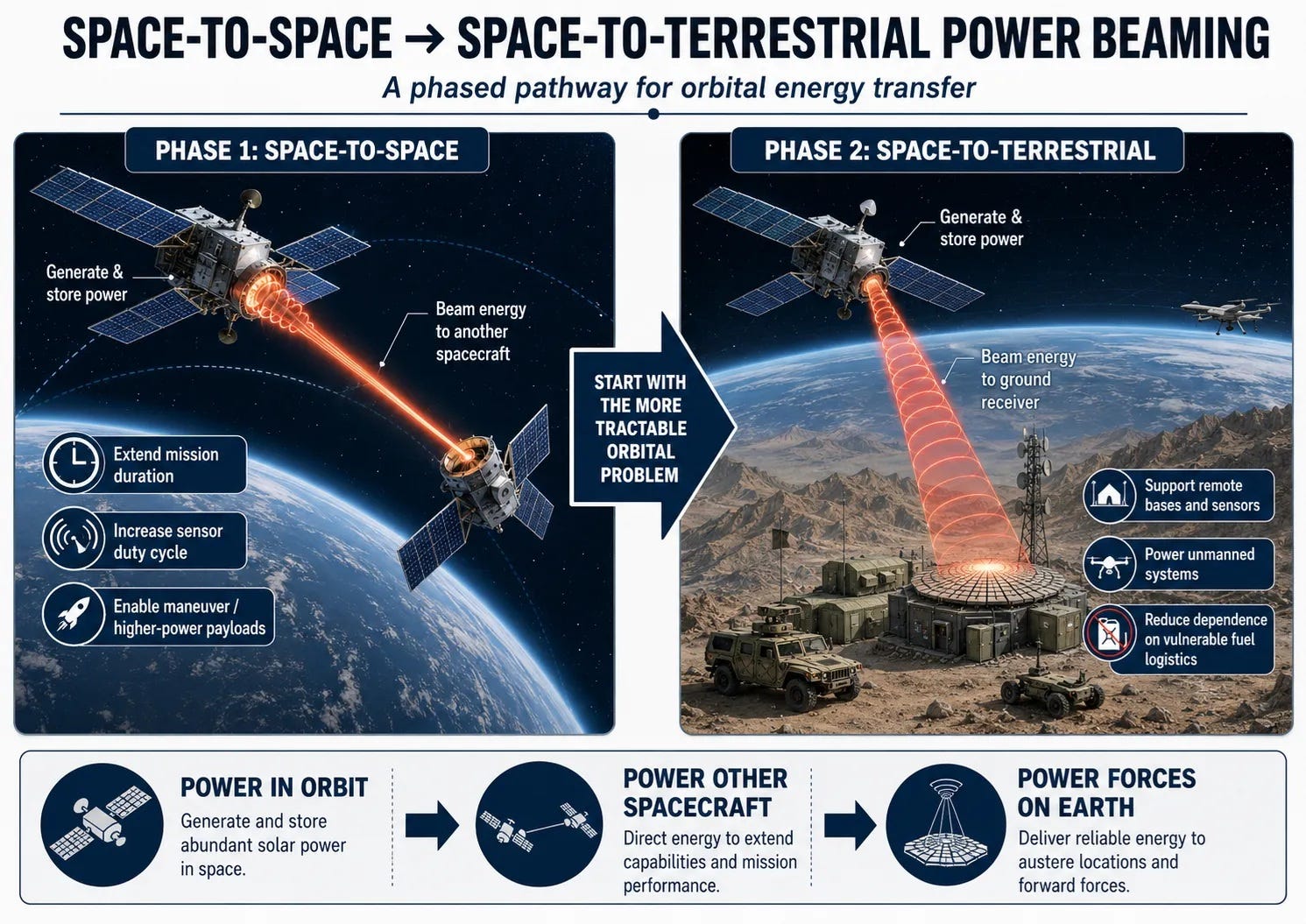
DIU is therefore seeking systems capable of transmitting power through directed electromagnetic energy rather than physical connections. Its solicitation includes four lines of effort: space-to-space power transmission, space-to-terrestrial power transmission, receivers, and next-generation components. The near-term goal is a low-Earth-orbit demonstration, followed by an operational capability around FY2030.
This, too, closely follows a concept for which Building Our Future has advocated for years and about which I’ve engaged DIU and other defense innovation ecosystem organizations. It’s noteworthy that the pathway I had advocated began with space-to-space power transfer, where the distances, receiver geometry, and operational use cases are more tractable, before attempting the much harder space-to-terrestrial problem.
A power-generating spacecraft could recharge or supplement other satellites, extend mission duration, increase duty cycles, and enable capabilities that cannot fit within the power budget of a conventional spacecraft. These are all necessary to the future of space warfare as we seek resilience, maneuverability, and longevity of our spacecraft in orbit.
Once established, the same architecture could eventually deliver energy to terrestrial receivers, unmanned systems, or forward locations without relying on vulnerable fuel convoys and fixed infrastructure.
Again, the Department is now investigating the right problem.
And again, it is doing so approximately three years after the concept and requirement were identified.
Innovation After Permission
To be clear, this criticism is not directed at the people inside DIU, many of whom understand these problems and work aggressively within the authorities and demand signals available to them.
DIU moves relatively quickly once it possesses a defined problem, an institutional customer, an acquisition pathway, and a credible route from prototype to adoption. Its Commercial Solutions Opening process can move companies from solicitation to prototype agreement much faster than conventional acquisition programs.
The deeper problem is structural.
DIU describes its process as soliciting commercial solutions for the current needs of its Department partners. It works with organizations across the military to identify challenges, while those partners generally fund the resulting prototypes and participate in their evaluation.
That model makes DIU an effective bridge between an established military demand and a commercial solution. It is less effective when the commercial ecosystem identifies a future operational requirement before a military customer has formally adopted it.
A company may see the emerging requirement. A venture investor may understand the technology. A futurist may articulate the operational concept. DIU personnel themselves may agree that the capability will eventually matter.
But until a service, combatant command, program office, or other organization accepts the problem and becomes an institutional customer prepared to test, adopt, and scale a solution, the idea can remain suspended between recognition and action.
That is how an organization intended to accelerate innovation can still inherit the latency of the larger institution around it.
The Department routinely asks companies to invest ahead of demand. Yet when those companies correctly anticipate future military requirements, the government often cannot act until its internal planning, requirements, programming, and budgeting processes catch up.
This creates a brutal paradox for defense startups.
Arrive after the requirement is established, and a better-capitalized competitor or traditional prime may already control the market. Arrive before the requirement is established, and the company may exhaust its capital waiting for the Pentagon to become ready to buy.
The United States frequently celebrates entrepreneurs who are ahead of their time. Its defense acquisition system frequently punishes them for it.
The Cost of Institutional Latency
These three initiatives demonstrate real progress in the pursuit of a more flexible and resilient capability for the future force.
The Pentagon is establishing multiyear demand for lower-cost missiles. DIU is pursuing massed, attritable aircraft. It is investigating orbital power infrastructure that could transform both spacecraft design and military logistics.
All three deserve support.
But they also expose the gap between identifying the future of warfare and building for it.
A military can possess brilliant futurists, innovative acquisition organizations, sophisticated wargames, and extensive lessons-learned programs while still adapting too slowly. Insight only becomes militarily useful when it changes budgets, requirements, organizations, production lines, and fielded formations.
The clock begins when the operational problem becomes foreseeable, not when we publish a solicitation.
By that measure, the Department has already spent years reaching the starting line.
Modern war rewards institutions that can identify a changing requirement, experiment rapidly, accept imperfect early solutions, and scale what works. It punishes organizations that require broad consensus before beginning to move.
The lesson from this week is therefore encouraging, but uncomfortable.
The Pentagon is learning.
It still needs to learn much, much faster.
Keep building,
Andrew Glenn
Founding Editor, Building Our Future
Epic Fury
U.S. strikes, disables tanker approaching Iranian port, using Hellfire missiles (NPR)
Trump leans toward significant expansion of military operations in Iran (WSJ)
Some ships are refusing U.S. military guided transits through Strait of Hormuz (RT)
Iran tells Houthis to close Red Sea gateway if U.S. hits power network (RT)
Mums the word around the Pentagon on latest stage of Iran war (NYT)
Kuwait: Iran has attacked power and desalinization plant (AA)
News Headlines
Senior defense officials reportedly looking at military options against Cuba (CBS)
Zelenskyy shocks country with surprise shake-up, ousting defense minister Fedorov despite military gains (AP)
Trump alleges China election meddling, extending beyond what White House released documents prove and potentially risking wary truce between superpowers (RT)
China purges third Politburo member in deepening anti-graft drive (RT)
Defense & Dual-Use Technologies
DoD halts cybersecurity requirements for CMMC Phase 2 (DS)
New 3D-printed thermal cloak hides objects from heat in any direction (IE)
Pentagon launches testosterone screening program for troops (PBS)
Pentagon announces multiyear deals to buy thousands of ‘affordable’ cruise missiles (ASF)
DIU aims to reduce the military’s ‘cost per kill’ (DS)
Threat Tech
China, Russia have secret plan to ‘defeat’ Starlink (AT)
China explores new, long-term ways to hold off rivals in Asia from Coast Guard patrols to new SLBMs (DN)
Russia claims new tanks can stop FPV drones (KP)
Nearly 200 foreign defense firms register for Ukraine’s captured Russian weapons database (U24)
Foreign Defense Tech
European researchers fir next-gen electromagnetic railgun in first open-range trial (IE)
Europe’s Hydis project settles on concept for hypersonic interceptor (DN)
European firms plan exo-atmospheric interceptor for 2027 test (TDP)
Canada to plug surveillance gaps with Australian over-the-horizon radar (DN)
Franco-German defense cooperation under strain as Macron, Merz meet (DN)
Israel’s Elbit Systems wants to convert commercial ships into floating drone bases (NLT)
Rheinmetall, MBDA to develop laser weapon for German navy (DN)
Saudis cleared to buy 20,000 laser-guided rockets (TWZ)
Ukraine taps European allies to build Freya, a cheaper Patriot-alternative to Russia’s ballistic missiles (DN)
Defense Industry
Pressure mounts on U.S. defense executives to boost weapons production (DN)
U.S. industrial base is becoming stronger for wartime production: study (MT)
Blue Water Autonomy, Saildrone sue U.S. Navy after losing out on MUSV program (MT)
Autonomous Systems
New winged robot can swim and fly like a diving bird (MIT)
Air Force completes first-ever CCA live-fire test with Anduril YFQ-44A (MT)
New ForceField counter-UAS system from Axon Vision stops FPV drone attacks without emitting signals (IE)
Marines use anti-drone netting during recent exercise (TWZ)
Finance & Deal Flow
Funds
U.K.-based Lakestar closed its $300M Resilience I fund dedicated to defense and dual-use technologies (EUS)
VC
Helsing raised a $1.8B Series E at an $18B valuation led by Dragoneer to support the development of autonomous systems and next-gen defense platforms for Europe and to expand operations to the United States through a new plant in West Virginia (TEU)
BRINC, a public safety drone technology company, raised a $125M round led by Motorola Solutions (PRN)
Singularity emerged from stealth with the announcement it had raised an $80M Series A at a $400M valuation and led by Khosla Ventures and Felicis to build low-cost air defense at scale (PU)
PE / M&A / Exits / Other
Aerospace parts maker TransDigm walked away from its $960M takeover of rival Stellant Systems after DOJ threatened to block the deal (BBG)
U.K. PE firm Bridgepoint will acquire a majority stake in Danish defense tech firm UMag Solutions at a $286M valuation (PU)
Aequita-backed German military supplier SMAG Mobile Antenna Masts tumbled 42% in its trading debut after raising $128M in a German IPO (BBG)
Exciting Opportunities
DIU is seeking systems that impose cheap, persistent pressure and force adversaries to expend scarce air-defense resources--in essence, it wants missile sponges (DIU)
Editor’s Picks
Atlas Special Projects CEO Joey Gagnard feels that export controls are suffocating U.S. defense businesses.
BMNT CEO Peter Newell issues some caveats around recent acquisition reform.
Lighter Side

Keep Building,
BOF
The core of structural problems are cultural. Until and unless you change culture, which will require changing some percentage of the workforce, you will never truly address structural problems.